What Is a Heavy Duty Laptop? The Complete Buyer's Guide
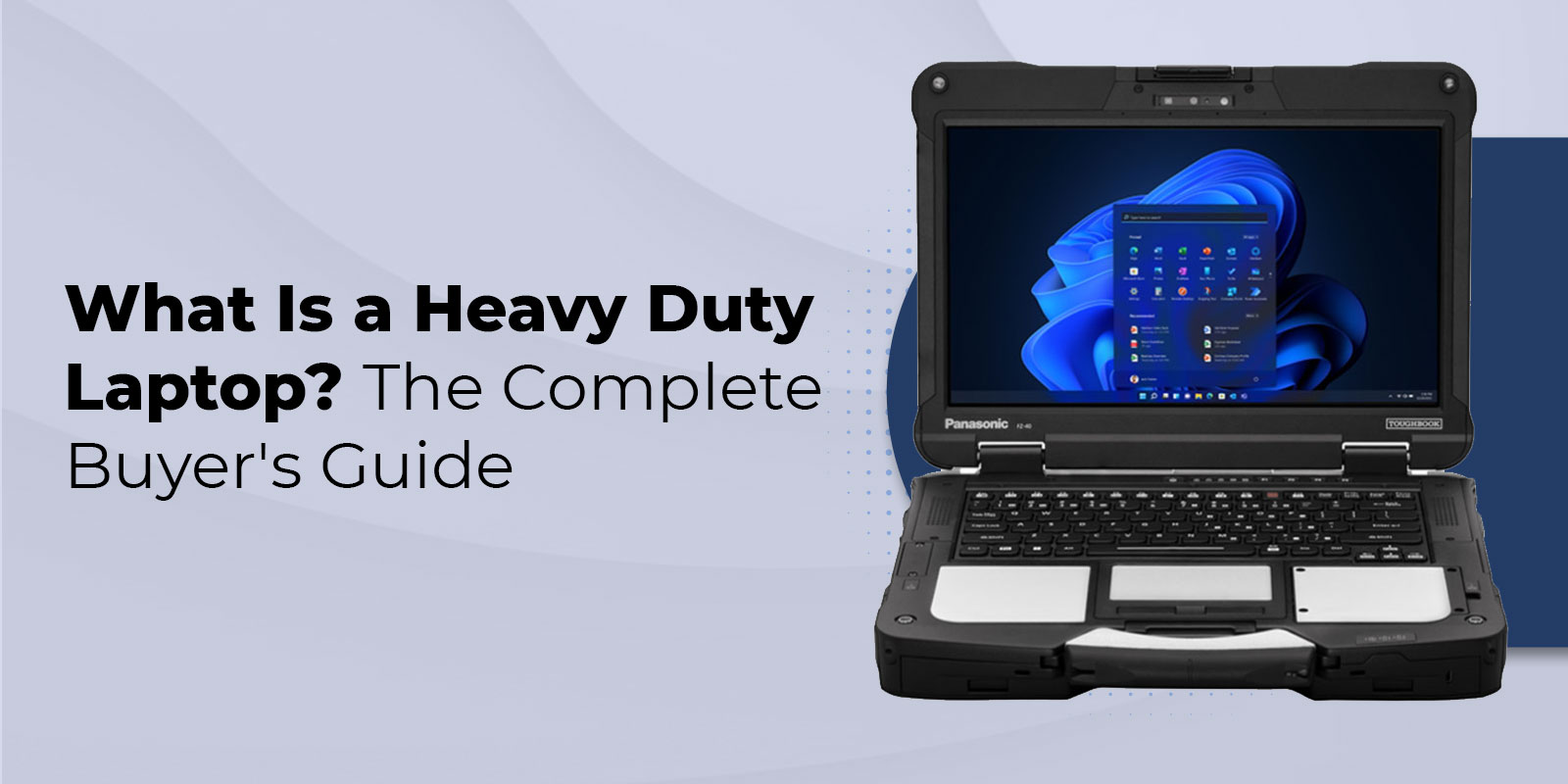
A heavy-duty laptop is a ruggedized computing device engineered to withstand drops, dust, water, extreme temperatures, and vibration that destroy standard laptops. Built to MIL-STD-810G/H military standards and IP65/IP66 ingress protection ratings, heavy-duty laptops are used by construction crews, law enforcement, utility workers, and military personnel who cannot afford device failure in the field.
In a controlled office environment, a standard laptop works fine. Put that same device on a construction site for six months - concrete dust, rain, 100-degree heat, accidental drops from a scaffold - and you have likely burned through two or three replacements. Industry data shows consumer laptops fail at a rate of nearly 30% within three years under normal conditions. In harsh field environments, that timeline compresses to six to eighteen months.
The total cost of that failure isn't just the replacement device. It's the field crew standing idle while IT sources a new unit. The project data was lost because the drive wasn't shock-mounted. It's the liability of a device failing at a critical moment on a job site or in a patrol vehicle.
This guide covers everything you need to select the right heavy-duty laptop: how military certifications actually work, how to choose between fully rugged and semi-rugged models, which Panasonic Toughbook configurations perform best by industry, and how to evaluate true total cost of ownership. For personalized guidance, see our complete rugged laptop buying guide - or call 800-441-9165 to speak directly with a specialist who has been matching buyers to the right Toughbook since 1999.
Heavy Duty Laptop vs. Regular Laptop: What's the Difference?
Consumer Laptop Limitations in Demanding Environments
Standard consumer laptops are engineered for one environment: the temperature-controlled, relatively clean office. Their plastic chassis flexes under impact rather than absorbing it. Open cooling vents invite dust ingress with every fan cycle. They have no vibration-damping for internal drives or circuit boards. A single drop from desk height onto a hard floor frequently permanently ends a consumer device.
For a field team of twenty devices experiencing that 30% failure rate, you're replacing six to eight units annually - before factoring in the data loss, IT labor, and field crew downtime that accompany each failure. In environments like construction sites, patrol vehicles, or utility trucks, conditions are harder, and failures come faster.
What Makes a Laptop Truly 'Heavy Duty'
A genuinely heavy-duty laptop is rebuilt from the inside out for deployment in demanding conditions. The differences begin at the chassis: military-grade magnesium alloy or carbon fiber construction absorbs and distributes impact energy rather than fracturing. Internal circuit boards receive a conformal coating - a thin, moisture-resistant layer that protects components from condensation and humidity.
Drives are shock-mounted on isolation systems that absorb vibration before it reaches the storage hardware. Externally, sealed ports and gasketed connectors prevent dust and moisture ingress. Operating temperature ranges extend from -20 degrees F to 140 degrees F in fully rugged models, compared to the 50 to 95 degrees F range typical of consumer hardware.
None of these features is a marketing claim in certified rugged devices. They are verified by military testing standards, which distinguish legitimate heavy-duty laptops from devices that simply look the part. The next section covers what that certification actually involves. For additional background, see our breakdown of what 'military-grade' really means in a laptop.
Military-Grade Certifications Explained
MIL-STD-810G vs. MIL-STD-810H - What They Actually Test
MIL-STD-810 is a U.S. Department of Defense environmental testing standard originally developed to qualify hardware for military field deployment. The standard covers 26 individual laboratory test methods. Tests most relevant to heavy-duty laptops include:
- Drop testing from specified heights onto concrete surfaces
- Vibration exposure simulating vehicle transport over rough terrain
- Humidity cycling and condensation resistance over extended periods
- Extreme temperature operation, thermal shock, and storage extremes
- Altitude and low-pressure performance for high-elevation deployments
- Dust and sand ingress testing at sustained wind speeds
MIL-STD-810G was the governing standard from 2008 to 2019. MIL-STD-810H, the current standard, updated the drop test methodology and introduced new test categories to reflect modern operational environments. Learn more in our detailed MIL-STD-810G/H standards explainer.
Critical buyer warning: The phrase 'MIL-STD-810 tested' does not mean all 26 test methods were passed. A manufacturer can test using three methods, pass those three, and make a broad certification claim. When evaluating a device for mission-critical use, ask specifically which test methods were conducted. Panasonic Toughbooks are tested across all applicable MIL-STD-810G/H categories - a distinction with real consequences in the field.
IP Ratings: IP65 vs. IP66 for Heavy Duty Laptops
IP (Ingress Protection) ratings certify a device's resistance to dust and liquid intrusion. The two-digit code works as follows: the first digit (0-6) measures dust protection, where 6 means fully dustproof; the second digit (0-9K) measures water resistance, where 5 means protected from water jets at any angle and 6 means protected from powerful water jets.
For heavy-duty laptops, IP65 is the standard minimum for most field deployments - fully dustproof and water-jet resistant. IP66 is required for field crews with daily rain exposure or high-pressure wash-down environments. Our full breakdown of what the IP65 rating really means covers the full ingress scale in practical terms.
Fully Rugged vs. Semi-Rugged: Which Heavy Duty Laptop Do You Need?
Heavy-duty laptops fall into two distinct categories: fully rugged and semi-rugged. The right choice depends on your team's specific exposure level - not just a general sense of 'outdoor work.' The comparison below covers the key differentiators. For a deeper breakdown, see our dedicated guide on semi-rugged vs. fully rugged laptops.
|
Feature |
Semi-Rugged |
Fully Rugged |
|---|---|---|
|
Drop Rating |
3-4 ft (0.9-1.2m) |
4-6 ft (1.2-1.8m) |
|
IP Rating (typical) |
IP53 - IP54 |
IP65 - IP66 |
|
MIL-STD Testing |
Selected methods |
All applicable methods |
|
Typical Weight |
4-6 lbs |
6-9 lbs |
|
Operating Temperature |
-4 to 131 deg F |
-20 to 140 deg F |
|
Battery |
8-14 hrs (single) |
12-36 hrs (dual/hot-swap) |
|
Best For |
Inspectors, supervisors, mixed indoor/outdoor |
Field crews, public safety, military, utilities |
|
New Device Price |
$1,500 - $3,000 |
$3,500 - $6,000+ |
|
Refurbished (TRL) |
$300 - $900 |
$600 - $1,800 |
|
TRL Recommendation |
When to Choose a Fully Rugged Heavy Duty Laptop
Fully rugged laptops are the correct choice when the device faces daily outdoor exposure - not occasional site visits, but constant deployment in environments where drops, rain, dust, mud, or temperature extremes are routine. Choose a fully rugged laptop when:
- The device is vehicle-mounted and docked/undocked multiple times per shift in a patrol car, utility truck, or construction vehicle
- Device failure creates a safety risk or mission-critical workflow gap (public safety, utilities, military operations)
- Operating temperatures regularly fall below -4 degrees F or exceed 131 degrees F
- Rain, dust, or water exposure is a daily rather than an incidental condition
When a Semi-Rugged Laptop Is Enough
Semi-rugged laptops are built for professionals who move between controlled environments and field settings, but whose devices aren't subject to sustained daily outdoor conditions. A semi-rugged Toughbook suits project managers who visit a site in the afternoon, inspectors who work from a truck cab, or mobile supervisors who need something tougher than a consumer device without the full weight of a field-hardened unit.
When primary concerns are occasional drops, light dust exposure, and standard mobile workflow - rather than daily rain, extreme temperatures, or mission-critical deployment - a semi-rugged device typically delivers superior value at a lower cost point.
Which category fits your team's workflow?
Call our Toughbook specialists at 800-441-9165 for a free consultation.
We've matched buyers to the right rugged computing configuration for 25+ years.
Top Heavy Duty Laptop Models from Panasonic Toughbook
Panasonic Toughbook is the dominant name in heavy-duty computing, and for good reason: the line has been fielded by law enforcement, military, utilities, and construction companies for over two decades. The three models below represent the most relevant configurations for most buyer profiles, ranging from fully rugged field deployment to semi-rugged mobile use.
|
Model |
Rugged Level |
MIL-STD |
IP Rating |
Battery Life |
Best For |
|---|---|---|---|---|---|
|
Fully Rugged |
810H + 461G |
IP66 |
Up to 36 hrs (dual) |
Extreme field, military, public safety |
|
|
Semi-Rugged |
810H |
IP53 |
Up to 38 hrs (dual) |
Construction, field engineering, mixed-use |
|
|
Fully Rugged |
810G |
IP65 |
Up to 9 hrs |
Law enforcement, proven refurb platform |
Panasonic Toughbook 40 - Best Fully Rugged Heavy Duty Laptop
The Toughbook 40 is the current benchmark for fully rugged computing. Its certification stack - MIL-STD-810H, MIL-STD-461G, and IP66 - represents the most comprehensive environmental testing available in a production rugged laptop.
The defining feature is the modular xPAK system, which allows teams to configure expansion ports, storage modules, fingerprint readers, smart card readers, and vehicle docking options without opening the chassis. As mission requirements change, the device adapts - without replacement.
Internally, the Toughbook 40 runs Intel Core Ultra processors with up to 32GB RAM and 1TB SSD. Its 1,200-nit sunlight-readable touchscreen remains fully legible in direct outdoor light. Hot-swappable dual batteries provide up to 36 hours of runtime, eliminating shutdown during battery swaps in the middle of a shift.
Panasonic Toughbook FZ-55 - Best Semi-Rugged Heavy Duty Laptop
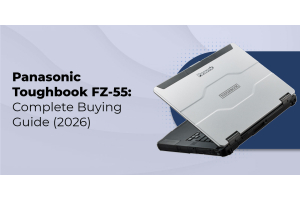
The Toughbook FZ-55 is the most modular semi-rugged laptop in production. Six sub-components are field-swappable by users without tools: primary battery, secondary battery, optical drive, smartcard reader, barcode scanner, and contactless card reader. This flexibility makes the FZ-55 adaptable across construction, field engineering, healthcare, and government workflows without requiring separate device configurations.
MIL-STD-810H certification and IP53 protection cover the most common field conditions short of daily immersion. The 14-inch FHD touchscreen supports gloved input - a practical requirement on construction sites and industrial environments where PPE cannot be removed to operate a standard touchscreen. Optional dual batteries extend runtime to 38 hours.
Panasonic Toughbook CF-31 - The Heavy Duty Laptop Standard for Law Enforcement
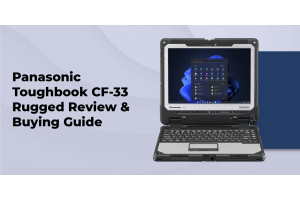
No fully rugged laptop has a more proven record of law enforcement deployments than the Toughbook CF-31. Tested to MIL-STD-810G, IP65-rated, and drop-tested at 6 feet, it served as the dominant mobile data terminal platform in North American patrol vehicles for over a decade.
TRL carries certified refurbished CF-31 units at a fraction of new-device cost - professionally tested, recertified to full functionality, and shipped with a warranty. For agencies operating on constrained budgets or building backup unit inventory, the CF-31 refurbished platform delivers fully rugged capability without fully rugged pricing.
Browse our full lineup of heavy-duty ToughBooks:
Shop New Toughbooks | Shop Certified Refurbished Models
Factory-direct pricing | Same-day shipping on in-stock models | Lifetime technical support
Industries That Rely on Heavy-Duty Laptops
Law Enforcement and Public Safety
Police and public safety computing demands are unique: the device must withstand continuous patrol-vehicle vibration, operate across extreme temperature ranges, and remain operational during high-stress incidents when failure is unacceptable. In-vehicle MDT (Mobile Data Terminal) deployments require an IP-rated, MIL-STD-certified device with a compatible vehicle docking station and sunlight-readable display.
The Toughbook CF-31 became the default platform for this application over a decade of law enforcement deployments across North America. See our dedicated guide on why police departments choose rugged laptops, or browse our police laptops category for current inventory.
Construction and Field Engineering
Concrete dust, rain, tool impacts, drops from heights, and temperature extremes make construction sites among the most demanding environments for any electronic device. Consumer laptops brought on-site typically fail within months under these conditions.
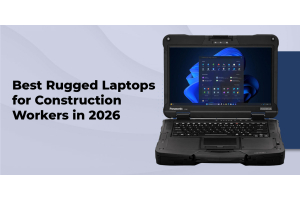
Crews running CAD, BIM, project management, or field reporting applications should evaluate the FZ-55 for mixed-use deployments and the Toughbook 40 for full outdoor exposure with daily rain or heavy dust. Glove-compatible touchscreen support is essential - field workers cannot remove gloves to type. Review our detailed guide to the best rugged laptops for construction workers for a full breakdown by job role.
Utilities and Industrial Field Service
Utility field crews face some of the most demanding computing conditions in industry: high-vibration vehicle environments, outdoor temperature extremes, and, in some cases, HazLoc (hazardous location) environments requiring C1D2 certification for use near explosive gases or dust. Hot-swappable batteries on the Toughbook 40 and FZ-55 are particularly valuable here - utility crews on long shifts cannot afford a device shutdown to replace a battery.
For a broader look at what separates a capable heavy-duty laptop from a marginal one in field deployment, see our guide on rugged laptop features that matter for field work.
Military and Government
Federal procurement requires TAA (Trade Agreements Act) compliant devices, confirming manufacture in the United States or an allied nation. Both the Toughbook 40 and CF-31 are TAA-compliant. Government agencies frequently require FIPS 140-2 encryption, smart card readers, and CAC (Common Access Card) readers- all supported across the Toughbook line.
TRL sources TAA-compliant configurations for government buyers and supplies the procurement documentation required for federal contracts. Browse our government laptops and military laptops pages for current TAA-compliant inventory.
Is a Heavy Duty Laptop Worth the Investment? A 5-Year TCO Analysis
The sticker price comparison between a $799 consumer laptop and a $3,999 Toughbook is easy to frame as an argument against rugged computing. The total cost of ownership comparison - run honestly over a five-year horizon- typically reverses that conclusion.
The real cost of the 'cheaper' device: A consumer laptop, replaced every 18 months in a field environment, generates roughly 3 replacement purchases over 5 years. Add data recovery costs when non-shock-mounted drives fail on impact ($500 to $2,000 per incident), IT labor for each rebuild and reconfiguration, and the field crew downtime during each replacement cycle. A realistic five-year total for a single consumer device in field service runs $5,000 to $8,000 - without factoring in OSHA considerations if a device failure creates a safety documentation gap.
The rugged device over the same period: A certified refurbished Toughbook CF-31 from TRL starts under $500. A new Toughbook FZ-55 runs approximately $2,499. Either device, properly maintained, operates for five to seven years under the same conditions that exhaust a consumer device in under two years.
Additional TCO factors that compound the advantage:
- Data integrity: Consumer drives are not shock-mounted. A single drop can cause catastrophic data loss. Toughbook drives are isolated from shock events - data survives the impacts that destroy consumer hardware.
- IT fleet management: Standardizing a field team on a single Toughbook model significantly reduces IT support complexity, spare parts inventory, and training burden over a multi-year cycle.
- Refurbished entry point: TRL's certified refurbishment program provides fully rugged capability at 60-75% below new-device pricing. The TCO argument for heavy-duty computing holds even at the smallest fleet sizes.
For a detailed breakdown of how this calculates across different device categories, see our comparison of semi-rugged vs. fully rugged laptops and the total cost factors involved.
Frequently Asked Questions About Heavy Duty Laptops
1: What is the difference between a heavy-duty laptop and a regular laptop?
Heavy-duty laptops are built from reinforced materials - typically magnesium alloy or carbon fiber chassis - and tested to MIL-STD-810G/H military standards for drops, vibration, temperature extremes, dust, and moisture. They feature sealed ports, shock-mounted drives, and IP-rated ingress protection. Regular consumer laptops are designed for controlled indoor environments and fail rapidly under the conditions that heavy-duty models are purpose-built to survive.
2: What does MIL-STD-810 mean for a heavy-duty laptop?
MIL-STD-810 is a U.S. Department of Defense testing standard covering 26 environmental test methods, including drop testing, vibration, extreme temperature, humidity, and altitude exposure. Note: the claim 'MIL-STD-810 tested' does not automatically mean all 26 methods were completed - ask which specific tests were conducted.
3: Is a refurbished heavy-duty laptop a good option?
Yes. Certified refurbished Toughbooks from TRL provide 60-75% savings compared to new, while maintaining full rugged performance. Every unit is professionally tested, recertified to full functionality, and ships with a warranty. Our certified refurbished Toughbook inventory is ideal for budget-conscious fleets, pilot programs, and backup-unit deployments.
4: What IP rating should a heavy-duty laptop have?
For most field environments, IP65 is the minimum recommended rating - fully dustproof and protected from water jets in any direction. Construction and industrial applications with daily rain or pressure wash-down exposure should target IP66. For a full explanation of the IP scale, see our guide on what the IP65 rating really means.
5: How long does a heavy-duty laptop last?
Properly maintained Panasonic Toughbooks regularly operate for 5-10 years under demanding field conditions. Consumer laptops used in the same environments typically fail within 6-18 months. The extended service life is the primary driver of the lower total cost of ownership for heavy-duty devices over a 3-5-year fleet cycle.
6: What is the best heavy-duty laptop for construction?
The Panasonic Toughbook FZ-55 is the leading semi-rugged recommendation for most construction deployments - modular design, glove-compatible touchscreen, 38-hour battery, and MIL-STD-810H certification handle the majority of jobsite conditions. For crews with daily exposure to rain or heavy concrete dust, the fully rugged Toughbook 40 with IP66 protection offers stronger protection. See our full guide to the best rugged laptops for construction workers.
7: Do heavy-duty laptops require special vehicle mounts?
Yes. Heavy-duty laptops deployed in fleet vehicles - patrol cars, utility trucks, construction equipment - require compatible vehicle docking stations and mount systems to prevent vibration damage and ensure secure in-vehicle deployment. TRL offers a full range of vehicle mounts compatible with all major Toughbook models.
Choosing the Right Heavy Duty Laptop for Your Team
A heavy-duty laptop isn't simply a more durable consumer device - it belongs to a different category, engineered from the ground up for environments where failure is not an option. MIL-STD-810G/H and IP65/IP66 ratings separate verified field protection from marketing language, and the total cost of ownership argument makes a compelling case even before accounting for the operational risk that comes with device failure in the field.
Matching the right device to the right deployment comes down to honest exposure assessment: daily outdoor conditions call for a fully rugged platform like the Toughbook 40; mixed indoor/outdoor workflows are well-served by the semi-rugged Toughbook FZ-55; law enforcement and agencies working from a proven platform should look hard at the certified refurbished Toughbook CF-31. For budget-driven deployments, TRL's certified refurbishment program brings fully rugged capability within reach of almost any fleet budget.
ToughRuggedLaptops.com has been sourcing, configuring, and supporting Panasonic Toughbooks for field teams across construction, law enforcement, utilities, and government since 1999. Lifetime technical support and same-day shipping on in-stock models are standard.