The Complete Police Laptop Buying Guide: Rugged Models, CJIS Compliance & Refurbished Options
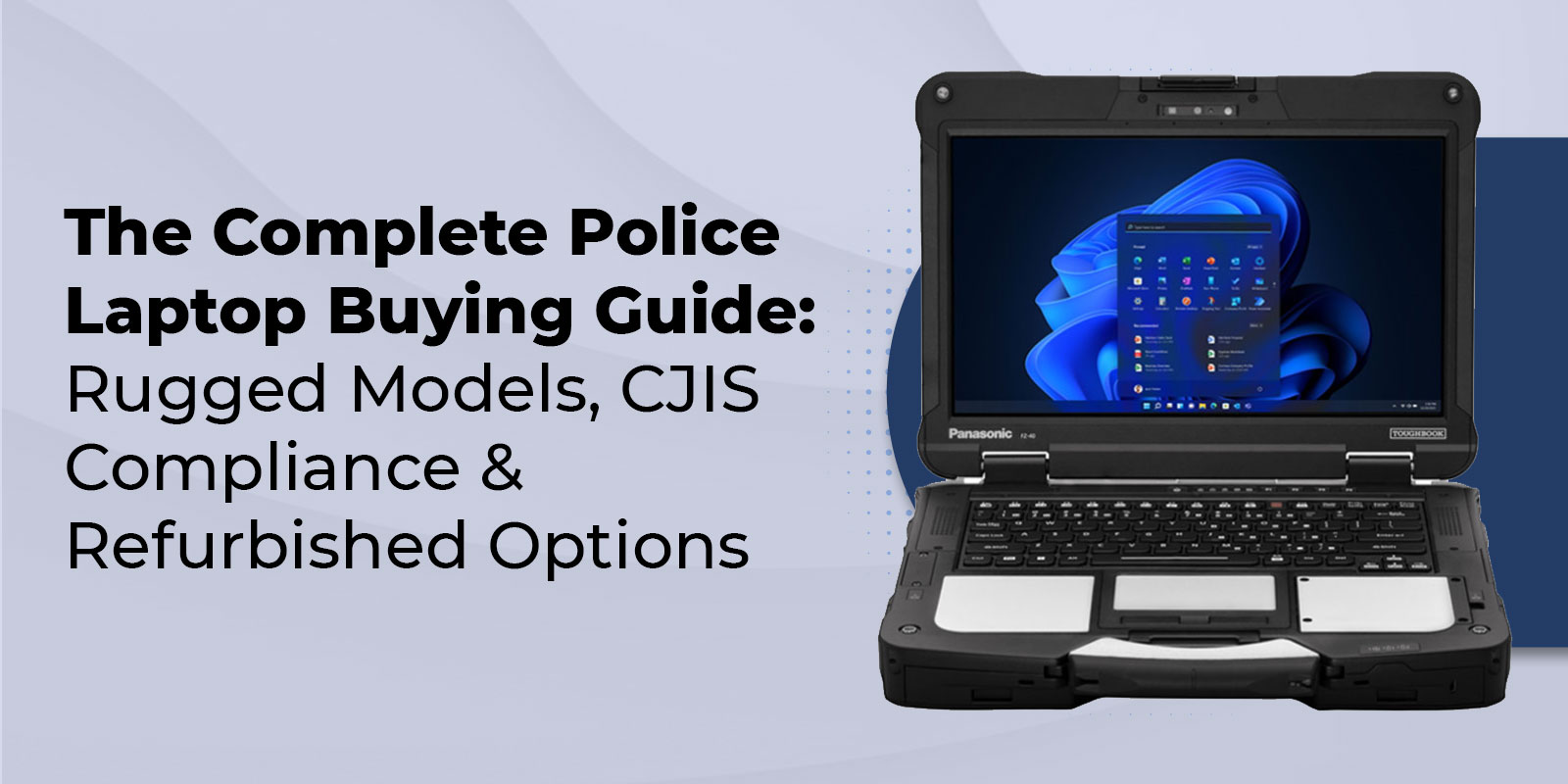
A police laptop is a rugged mobile data terminal designed for law enforcement fieldwork, built to withstand drops, vibration, dust, rain, and extreme temperatures while meeting CJIS security requirements. Unlike consumer laptops, a police laptop combines MIL-STD-810H durability testing, IP-rated sealing, sunlight-readable displays, hot-swap batteries, and FIPS-compliant encryption for patrol-car and on-foot use.
Police laptops serve as the officer's mobile office, the link between a patrol car and the department's criminal justice information systems. Choosing the right one is a mission-critical decision that affects officer safety, audit compliance, and a multi-year budget. This independent buying guide compares Panasonic Toughbook, Getac, Dell Rugged, and Durabook, walks through the CJIS 6.0 hardware requirements every agency must now meet, and explains when a refurbished unit beats new and when it does not.
What Is a Police Laptop? (And What Does MDT Mean?)
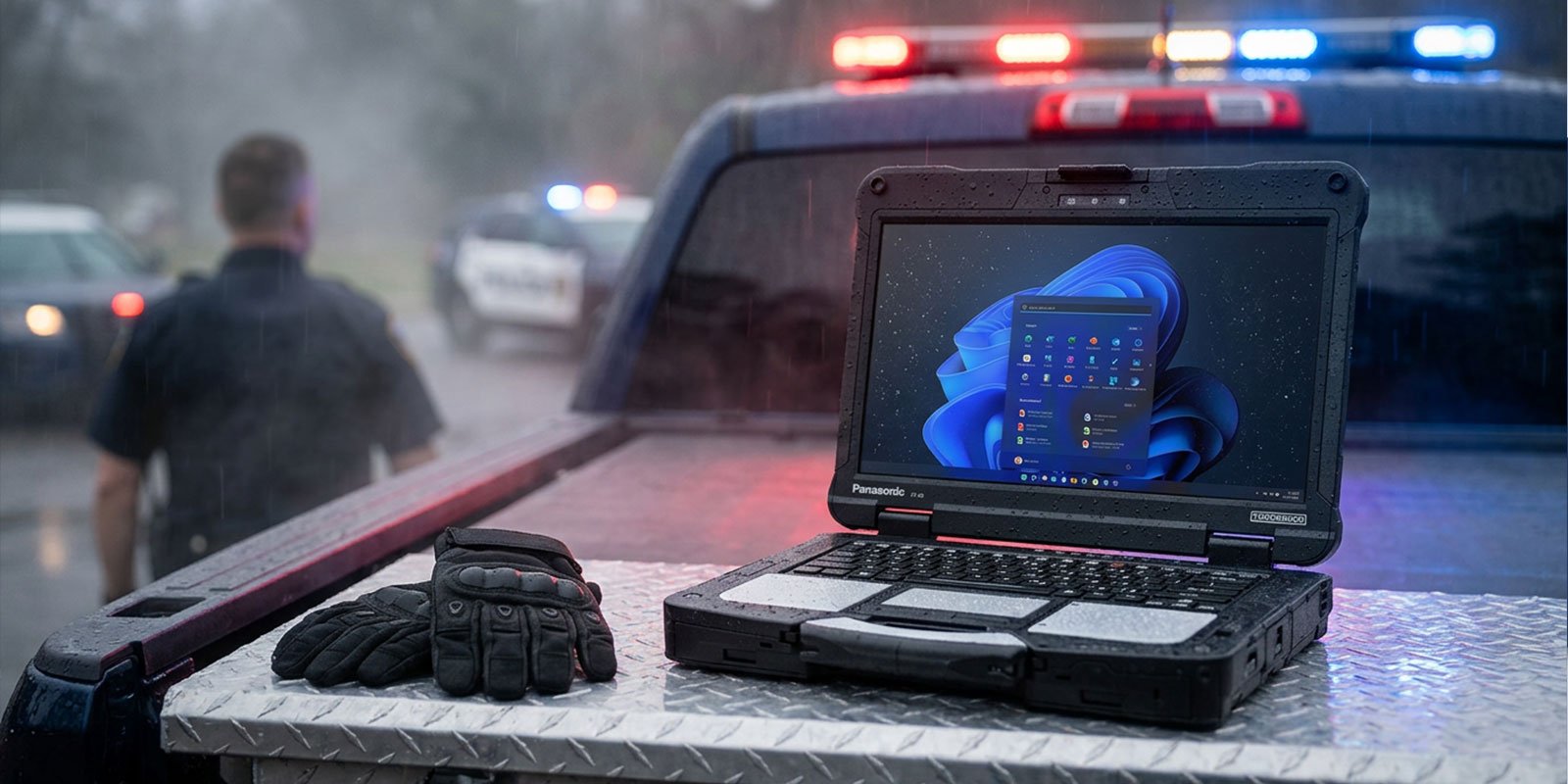
A police laptop, also called a mobile data terminal (MDT) or police mobile computer, is a ruggedized laptop used by law enforcement officers to access dispatch, write reports, query criminal records, issue electronic citations, and communicate with the department while in the field. MDT is the industry term: when vendors and procurement officers say MDT, they mean the in-vehicle police laptop. Some departments also use detachable 2-in-1 designs or rugged tablets for the same role.
Unlike a consumer laptop, or even a business-class corporate laptop, a police laptop is purpose-built around three constraints: survive everything the job throws at it, stay connected in every location, and pass a CJIS audit. Every feature that follows exists to satisfy one of those three constraints.
Why Regular Laptops Fail Police Work
A standard business laptop placed in a patrol vehicle will typically fail within 12 to 18 months. The causes are predictable: heat cycling from summer dash temperatures above 140°F, vibration from pursuits and off-pavement driving, drops during foot pursuits, and accidental coffee or rain exposure.
Beyond durability, consumer and BYOD (bring your own device) programs fail the CJIS security policy: they typically lack TPM 2.0, phishing-resistant MFA support, and the managed firmware integrity validation that CJIS now requires. Agencies running BYOD programs almost always find themselves out of compliance at their three-year CJIS audit, which can result in revoked access to NCIC, NLETS, and other federal databases. [Internal link: why-police-departments-choose-rugged-laptops]
The 7 Features That Make a Laptop Rugged Enough for Police
Ruggedness is tested, not claimed. Look for specific standards, specific ratings, and specific test methods, not marketing adjectives.
1. MIL-STD-810H Drop, Shock, and Temperature Testing
MIL-STD-810H is the current US military environmental testing standard, issued in 2019 to supersede MIL-STD-810G. A fully rugged police laptop should pass the drop test (Method 516.8) from at least six feet onto plywood-over-concrete, temperature extremes from −20°F to 145°F, vibration, humidity, and altitude. Semi-rugged devices are only tested to 810H at lower levels, typically a three-to-four-foot drop. [Internal link: mil-std-810g-laptops-explained]
2. IP53 vs IP65 vs IP66 Water and Dust Ratings
Ingress Protection ratings come from IEC 60529 and tell you what the device can survive. The first digit is dust, the second is water. IP53 means protected against dust and light splashes, fine for a semi-rugged laptop in a patrol car. IP65 means dust-tight and resistant to water jets from any direction, appropriate for outdoor foot patrol. IP66 is dust-tight and survives heavy seas or powerful water jets. For mixed in-vehicle and on-foot work, IP65 is the standard to hold out for.
3. MIL-STD-461G Electromagnetic Compatibility
This is the feature almost no competing buying guide explains. Patrol cars are full of radios, antennas, and emergency lighting, all of which create strong electromagnetic fields. MIL-STD-461G certifies that a laptop will not interfere with those systems and will not be disrupted by them. If your department runs high-wattage VHF or UHF radios, MIL-STD-461G is not optional; it is a prerequisite.
4. Sunlight-Readable Display (1000+ Nits)
A display of 800 nits or less is unreadable in direct midday sunlight. Rugged police laptops typically ship with 1000-to-1200-nit displays, with anti-reflective coatings and transflective layers. For officers working outdoors during traffic stops or perimeter control, below 1000 nits is a non-starter.
5. Hot-Swap Batteries for Full-Shift Operation
A 12-hour shift with video capture, LTE, and a bright display burns through battery fast. Hot-swap dual-battery designs allow an officer to change one battery while the other keeps the system running, with no reboot and no dropped dispatch connection. Single-battery rugged laptops will fail on long shifts without a patrol-car charging dock, which in turn requires vehicle integration.
6. Spill-Resistant Keyboard and Glove-Touch Display
Officers frequently use devices wearing tactical gloves and in wet conditions. A true police laptop will have a sealed membrane keyboard rated for coffee and soda spills, plus a capacitive touchscreen that is reliably responsive through thick gloves. A consumer touchscreen that needs a bare fingertip is not acceptable for field use.
7. Magnesium Alloy Chassis and Sealed Port Covers
Consumer plastic housings crack under pursuit G-forces. A magnesium alloy chassis is rigid, light, and dissipates heat. Sealed port covers over every USB, HDMI, and Ethernet connection keep water and fine particulate out. Both are table stakes on fully rugged models.
Performance Specs Police Laptops Actually Need
Performance matters less than durability until you try to run ALPR, body-camera ingest, and a modern CAD/RMS client at once. Recommended minimums: Intel Core i5 or better (Core i7 for any Edge-AI workloads like license plate recognition), 16 GB RAM minimum with 32 GB recommended for agencies running AI-assisted analytics, and a 512 GB NVMe SSD with hardware-based encryption. Older HDD-based Toughbooks, still common in the refurbished market, should be upgraded to SSD before deployment.
CJIS 6.0 Compliance: The Hardware Features Required to Pass an Audit
This is the section most buying guides skip. The FBI's CJIS Security Policy was updated to version 6.0, and the hardware features required to stay compliant changed meaningfully. Agencies failing a three-year audit can lose access to NCIC, NLETS, and federal background-check databases.
FIPS 140-3 Encryption
FIPS 140-3 is the federal cryptographic module standard that replaced FIPS 140-2. CJIS 6.0 requires FIPS 140-3 validated encryption for Criminal Justice Information in transit and at rest outside of physically secured facilities. Your police laptop needs a FIPS 140-3 validated cryptographic module built into either the OS (Windows 11 with BitLocker in FIPS mode) or an OPAL 2.0 self-encrypting drive. Verify the validation certificate number before purchasing.
Phishing-Resistant Multi-Factor Authentication
Under CJIS 6.0, unlocking a device with a username and password no longer meets MFA requirements. Phishing-resistant MFA requires at least one physical factor: a smartcard, CAC, FIDO2 security key, or biometric reader tied to the device. A police laptop must support smartcard or CAC reader integration and preferably hardware FIDO2. Push-notification MFA alone is insufficient.
TPM 2.0 and Secure Boot
A Trusted Platform Module version 2.0 chip is required for Windows 11 and for device attestation in CJIS environments. Secure Boot prevents unsigned firmware or rootkits from loading before the operating system. Both are standard on modern rugged laptops but often disabled in refurbished units, so verify they are enabled before deployment.
BIOS Integrity Validation
CJIS Section SI-7 requires validity checks on hardware and firmware. Enterprise tools from Panasonic (Smart Compliance and TOUGHBOOK Total Defense) and HP Sure Start continuously verify BIOS integrity. A refurbished unit without this feature can still be deployed but must be paired with a separate endpoint integrity tool.
Connectivity for Patrol: FirstNet, 5G, and Dedicated GPS
Connectivity gaps are a top cause of officer frustration with police laptops. Look for four features specifically.
FirstNet and Band 14 Priority Access
FirstNet is the federal broadband network built specifically for first responders, operating on Band 14 with priority and preemption over commercial traffic. A police laptop intended for field use should be FirstNet Ready, certified with the right LTE band support, SIM slot configuration, and antenna. Many rugged laptops require the correct WWAN module option at purchase; retrofitting is expensive.
Dedicated GNSS/GPS Receiver
Assisted GPS that borrows tower data is not enough for CAD/AVL (computer-aided dispatch, automatic vehicle location). Police laptops need dedicated GNSS receivers, typically supporting GPS, GLONASS, Galileo, and BeiDou, for accurate location even without cellular coverage. This is a common gap on consumer-grade and BYOD devices.
5G Sub-6 and 4G LTE Failover
5G Sub-6 offers faster speeds where available, but coverage is incomplete, especially in rural patrol areas. A police laptop should support both 5G Sub-6 and 4G LTE with automatic failover, plus dual-SIM for commercial-and-FirstNet redundancy.
Wi-Fi 6E and Bluetooth 5.3
At the station and at docked patrol car workstations, Wi-Fi 6E gives the bandwidth headroom needed for video upload and evidence transfer. Bluetooth 5.3 supports modern body-camera and radio-integration accessories.
Choosing the Right Form Factor: Laptop, 2-in-1, or Tablet
Most agencies run a mix. The right choice depends on how officers actually work:
|
Form Factor |
Best For |
Example Models |
Tradeoff |
|
Traditional rugged laptop |
In-vehicle patrol; report-heavy work |
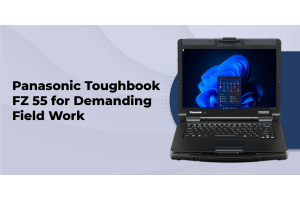
Panasonic TOUGHBOOK 55, TOUGHBOOK 40; Getac S410; Dell Latitude 5430 Rugged; Durabook S15 |
Less portable out of the car |
|
2-in-1 detachable |
Officers needing tablet mode at scenes; investigators |
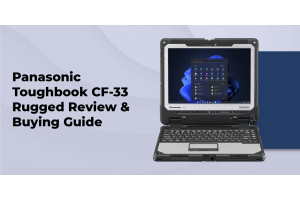
Panasonic TOUGHBOOK 33; Dell Latitude 7230 Rugged Extreme; Getac K120 |
Smaller keyboard; higher price |
|
Pure rugged tablet |
Foot patrol, bike, motorcycle, K-9, traffic units |
Panasonic TOUGHBOOK G2; Getac F110; Durabook R8 |
No physical keyboard by default; typing slower |
|
Semi-rugged laptop |
Admin, court prep, training; low-risk environments |
Panasonic TOUGHBOOK 56; Dell Latitude 5430 Rugged |
Lower drop/IP rating; not for patrol |
The 4 Police Laptop Brands Compared
Every major US law enforcement agency runs one or more of these four brands. The differences matter for procurement and for long-term fleet management.
|
Brand |
Strengths |
Tradeoffs |
Typical Price (New) |
Strong Fit For |
|
Panasonic TOUGHBOOK |
Industry-leading durability pedigree; modular xPAK expansion (barcode, smartcard, serial); largest US law enforcement installed base; strong refurbished market |
Highest upfront price; longer lead times on custom configs |
$3,500 to $6,400 |
Most departments; patrol-heavy fleets |
|
Getac |
FirstNet-ready; Edge AI support; better keyboard and touchpad; lower entry price than Panasonic |
Smaller US service footprint; less refurbished availability |
$2,800 to $5,200 |
Mid-size departments; AI-assisted workloads |
|
Dell Rugged (Latitude) |
Fits Dell enterprise management ecosystem; wide warranty options; easier IT integration for mixed fleets |
Leans semi-rugged; lower IP rating on some models |
$2,400 to $4,800 |
Mixed-device agencies standardized on Dell |
|
Durabook |
Best price-to-spec ratio; newest AI-ready workstation (Z14I-HG, 682 TOPS); customization options |
Smaller brand in US policing; thinner field support footprint |
$2,200 to $6,400 |
Budget-conscious agencies; specialized AI |
New vs. Refurbished Police Laptops: A Decision Framework
Refurbished fully rugged Toughbooks typically cost 40 to 60 percent less than new units while delivering most of the same useful service life. But refurbished is not always the right answer. Use this framework:
|
Choose NEW when... |
Choose REFURBISHED when... |
|
Running AI workloads (ALPR, facial recognition, speech-to-text) |
Budget-constrained small or rural agencies |
|
Committing to 7-year deployment with full manufacturer warranty |
Training, reserve, or auxiliary fleets |
|
TPM 2.0 and Windows 11 with FIPS 140-3 are mandatory |
Administrative or report-only use |
|
Department requires guaranteed 5G Sub-6 and FirstNet Band 14 |
Short-notice replacement of a failed unit |
|
Fleet standardization on a single brand year and model |
Pilot programs and evaluation before a full fleet buy |
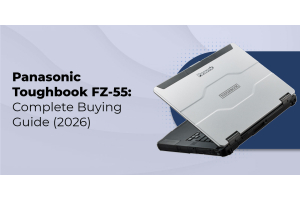
Refurbished police laptops from a Panasonic Premiere Partner typically ship with a one-to-three-year warranty, Windows 11 Pro, validated firmware, and the option to add TPM 2.0 enablement, Secure Boot, and CJIS-ready configurations. A refurbished TOUGHBOOK 33 or FZ-55 can land in a patrol car for roughly 40 percent of new-unit cost with most of the field usefulness intact. [Internal link: /police-laptops.html]
Vehicle Docks and Mounting Systems
A police laptop is only as reliable as its mount. The three dock ecosystems that matter for US law enforcement are Havis, Gamber-Johnson, and Precision Mounting Technologies. All three produce pedestal mounts and dock stations for Ford Police Interceptor Utility, Chevy Tahoe PPV, and Dodge Charger Pursuit, the three dominant US patrol platforms.
Confirm the specific vehicle-year-dock-model matrix before procurement: a 2024 Tahoe PPV dock will not fit a 2021 Explorer. For dockable laptops, verify that the dock supports pass-through for external GPS and LTE antennas. Without antenna pass-through, cellular performance inside the metal shell of the vehicle is meaningfully degraded. Also confirm that the combined laptop-plus-dock assembly has passed airbag deployment safety testing; a non-certified dock can become a projectile in a crash.
Total Cost of Ownership Over 5 Years
Upfront price is a poor comparison. Over five years, the real drivers are warranty, failure rate, repair cost, and redeployment value. Illustrative ranges for a single in-vehicle laptop:
|
Cost Component |
New Fully Rugged |
Refurbished Fully Rugged |
Consumer Business Laptop |
|
Upfront hardware |
$4,500 |
$1,800 |
$1,400 |
|
Vehicle dock + mount |
$700 |
$700 |
$700 |
|
5-year warranty |
Included or $600 |
$300 to $600 |
$400 |
|
Expected failures in 5 years |
0 to 1 |
1 to 2 |
3 to 5 |
|
Repair/replacement cost |
$200 |
$600 |
$4,200 (full replacements) |
|
5-year total (estimate) |
$5,400 |
$3,400 |
$6,700 |
The consumer laptop math fails because of cumulative replacement cost. Over five years, a $1,400 consumer laptop fleet often ends up more expensive than a new Toughbook fleet, and meaningfully less compliant with CJIS.
Frequently Asked Questions About Police Laptops
1. What laptops do cops use?
Most US police departments use Panasonic TOUGHBOOK models (CF-33, FZ-55, FZ-40, FZ-G2) for in-vehicle and field use, with Getac, Dell Rugged, and Durabook also deployed. Semi-rugged or consumer laptops are not used for patrol work because they cannot meet MIL-STD-810H durability testing or CJIS security requirements.
2. What brand do cops use?
Panasonic TOUGHBOOK is the dominant brand in US law enforcement, with an installed base in thousands of departments. Getac is the strongest alternative, particularly for departments prioritizing price-to-feature ratio and FirstNet readiness. Dell Rugged appears primarily in mixed-fleet agencies, and Durabook serves budget-sensitive and specialized AI workloads.
3. What is the laptop in a police car called?
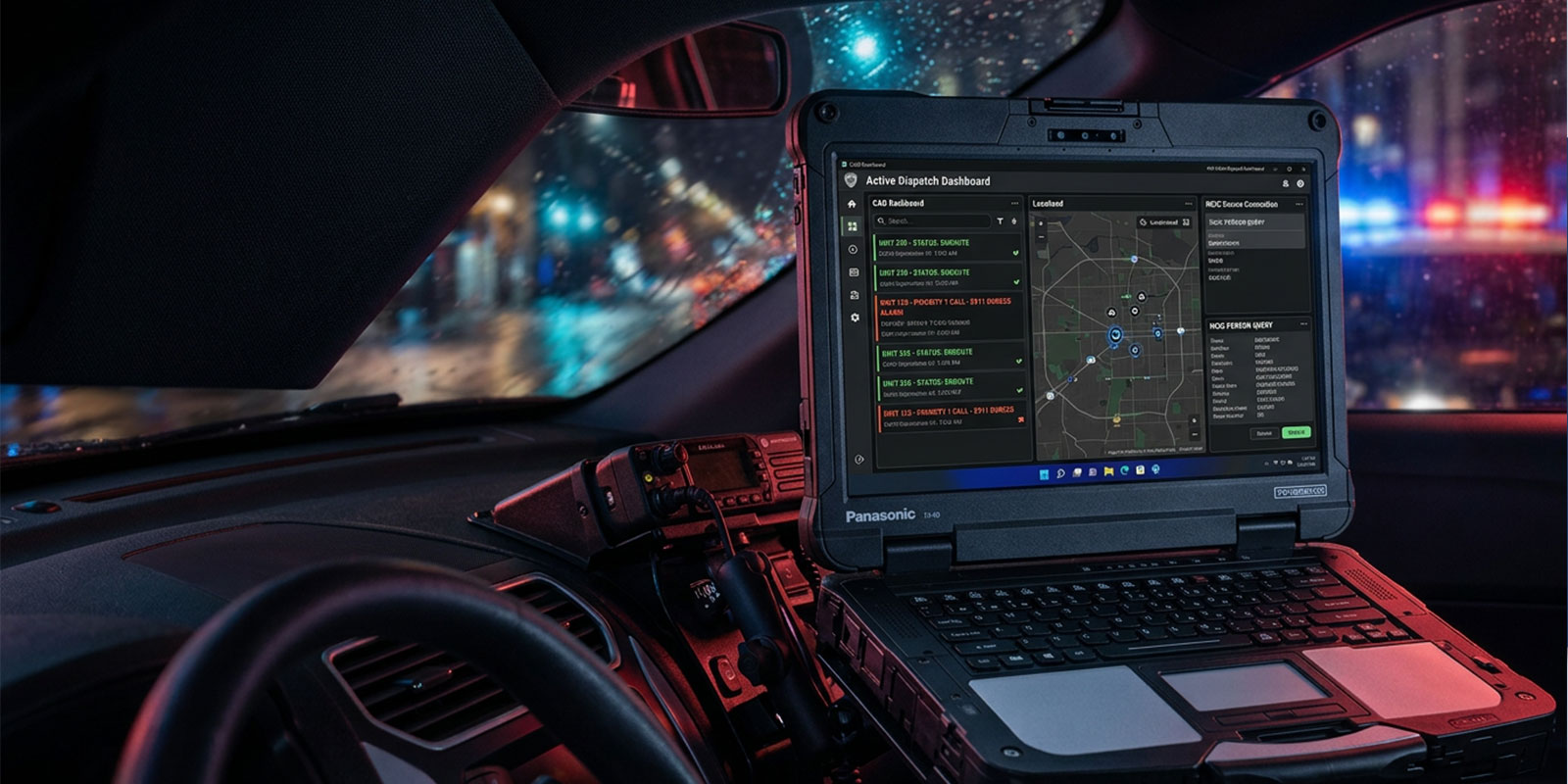
The laptop in a police car is called a mobile data terminal, or MDT. It connects to the department's CAD (computer-aided dispatch), RMS (records management), and NCIC (National Crime Information Center) systems. Most modern MDTs are detachable, so officers can remove them from the patrol car for field work at the scene.
4. How do police computers get internet?
Police computers connect to the internet primarily through FirstNet, the dedicated first-responder broadband network on Band 14, with 4G LTE and 5G Sub-6 as complementary or backup connections. Commercial cellular and Wi-Fi act as secondary networks. Patrol cars also often carry in-vehicle router/modems that create a mobile hotspot for connected equipment.
5. Why is Toughbook so expensive?
Toughbooks cost more because they are engineered to pass MIL-STD-810H testing, include FIPS-validated encryption modules, support hot-swap batteries and modular expansion, and carry multi-year service warranties. Panasonic reports a Toughbook annual failure rate of about 5 percent against an industry average of 10 to 15 percent, which delivers lower total cost of ownership despite the higher upfront price.
6. Are Toughbooks bulletproof?
Toughbooks are not bulletproof. They are certified for drops, shocks, vibration, temperature extremes, water, and dust, not ballistic impact. Police1 has reported field cases of rugged laptops continuing to function after being struck by gunfire, but that is outside any vendor's rated specifications and should not factor into procurement decisions.
7. Are police laptops secure?
Modern police laptops are built to pass CJIS 6.0 audits, which require FIPS 140-3 validated encryption, phishing-resistant multi-factor authentication, TPM 2.0, Secure Boot, BIOS integrity validation, and mobile device management. Security depends on the specific configuration deployed, so request the CJIS compliance documentation from your vendor before purchase.
8. Can civilians buy police laptops?
Yes. Rugged laptops are not restricted hardware. Civilians, contractors, security firms, government auxiliaries, field service engineers, and oil and gas workers routinely buy the same TOUGHBOOK, Getac, Dell Rugged, and Durabook models police departments use. Only certain CJIS-specific software and network access is restricted, not the hardware itself.
Choosing a Police Laptop Is a 5-to-7-Year Decision
The right police laptop touches officer safety, audit compliance, and department budget. Match your MIL-STD-810H and IP65 requirements to the patrol environment. Verify FIPS 140-3 and phishing-resistant MFA for CJIS 6.0. Pick a form factor matched to how officers actually work. Run the new-versus-refurbished math honestly.
When the math favors refurbished, a Panasonic Premiere Partner can deliver a fleet-ready TOUGHBOOK at a fraction of new-unit cost, with full CJIS-readiness, Windows 11 Pro, validated firmware, and warranty coverage.