Military Toughbook Laptops: Choosing the Right Rugged Device for Your Mission
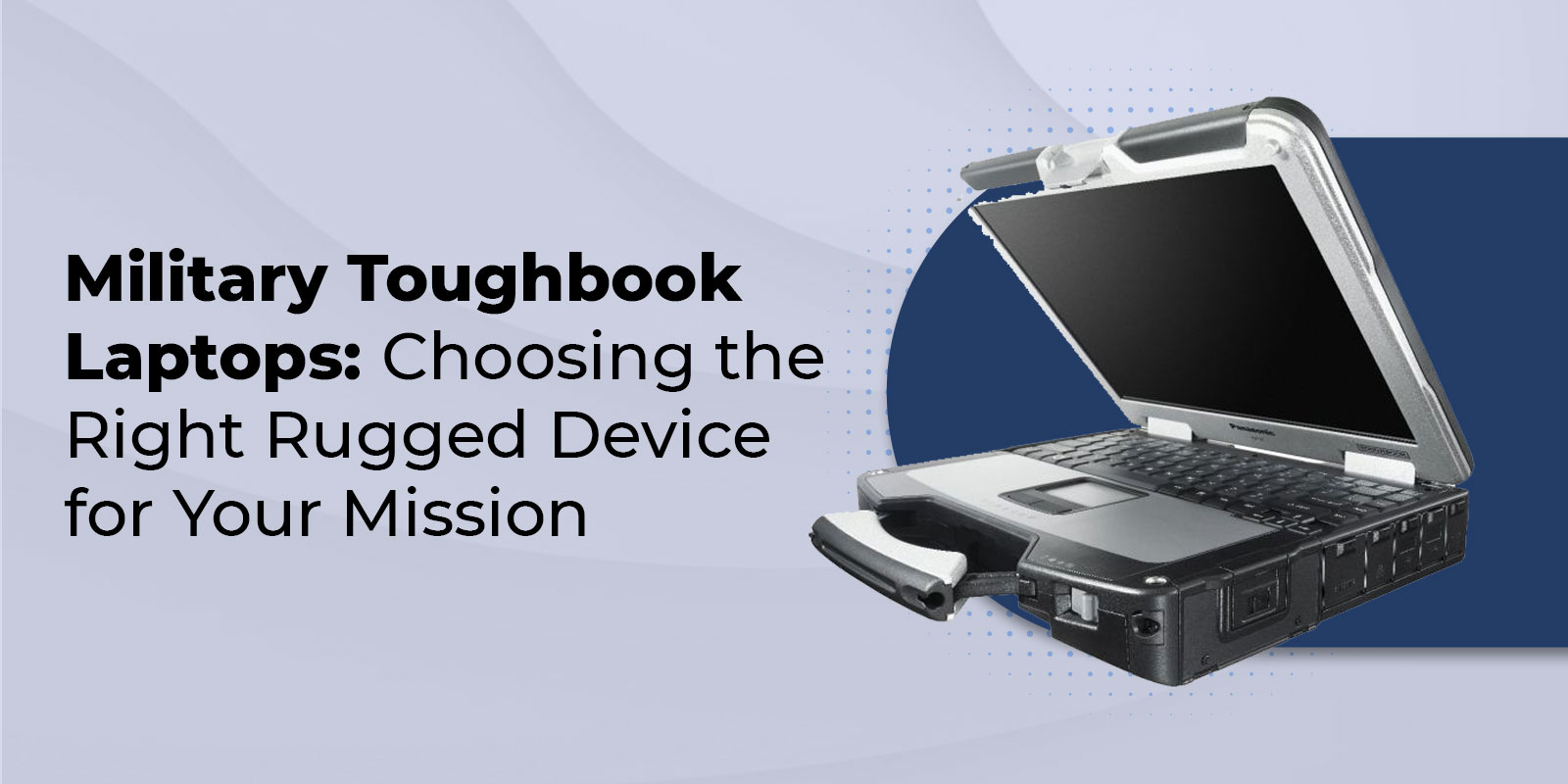
A consumer laptop lasts about three minutes in the field before sand, heat, or a hard drop ends its service life. A military Toughbook is a fully rugged Panasonic laptop or tablet engineered to survive the extreme conditions of active military service. Built to MIL-STD-810H standards, TAA compliant for U.S. government procurement, and field-tested across every branch of the armed forces, Toughbooks are the dominant rugged computing platform in the DoD. Whether the mission calls for battlefield communications, flight-line maintenance, or command and control in a forward operating base, there is a specific Toughbook model designed for that role.
We supply rugged Panasonic Toughbooks to military units, defense contractors, and federal agencies across the country at ToughRuggedLaptops. What follows is the most complete buyer's guide we have ever put together, matched to branch, mission, compliance requirements, and procurement pathway.
What Is a Military Toughbook?
A Panasonic Toughbook is not a laptop that has been reinforced after the fact. Every model is engineered from the ground up around a magnesium alloy chassis, shock-mounted internal components, sealed ports, and display glass tough enough to survive what a military workday actually looks like.
The baseline standard for any device used in U.S. military operations is MIL-STD-810H, the Department of Defense's environmental testing protocol. It covers 28 separate test methods, including drop resistance, vibration, thermal cycling from -20°C to +60°C on standard models, altitude, humidity, blowing sand, and salt fog. Earning that certification is not a marketing exercise. It means the device physically survived every test method relevant to its target deployment.
Panasonic has manufactured Toughbooks since 1997 and currently holds the largest share of rugged laptop deployments across DoD and federal civilian agencies. The rugged laptop market is dominated by a big three: Panasonic, Getac, and Dell, which together control roughly 70 percent of deployments, with Toughbook leading that group.
Which Military Branch Uses Which Toughbook?
No two military roles have identical computing requirements. Matching the right Toughbook to the right mission type is the most critical procurement decision, and it is one that most generic buying guides never address directly.
U.S. Army: Ground Operations and Field Command
Army field units operating in dismounted or vehicle-mounted roles need extended battery life, GPS integration, and full compatibility with ATAK (Android Tactical Assault Kit). The TOUGHBOOK 40 is our top recommendation for Army field deployments. Its eight modular expansion areas allow configuration with dedicated GPS receivers, additional storage, and specialized communications hardware. The hot-swappable bridge battery lets soldiers swap depleted cells without a shutdown, a decisive advantage during extended operations away from a power source.
The TOUGHBOOK 40 MK2, the current flagship version, is rated IP66, fully dustproof, and resistant to powerful water jets and carries a drop tolerance of 180 cm (roughly 6 feet). For vehicle-mounted command applications, it supports a full range of military docking solutions, including the TOUGHBOOK 40 Military variant developed with roda computer GmbH that integrates CAN Bus, MIL-DP, MIL-VGA, and MIL-DTL 38999 connectors for wheeled and tracked vehicle networks.
U.S. Navy: Maintenance and Flight-Line Operations
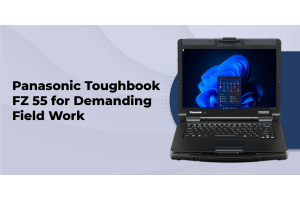
Navy and Marine Corps maintenance personnel work in an environment combining constant vibration, high humidity, and salt air, a combination that ends the service life of unrugged hardware quickly. The TOUGHBOOK 55 addresses those conditions directly. Its IP65 rating and MIL-STD-810H vibration certification cover the specific loads generated by maritime and airfield environments.
The 14-inch touchscreen on the TOUGHBOOK 55 is calibrated for glove touch and rain sensing, meaning technicians wearing work gloves or working in precipitation can interact with the display without removing either. An optional high-brightness panel rated for sunlight-readable use matters on a carrier flight deck or an exposed pier, where screen legibility in direct light is a daily requirement. Navy and Air Force personnel regularly use Toughbooks to access digital maintenance manuals and technical order systems, making that display quality non-negotiable.
U.S. Air Force: Logistics, Intelligence, and Base Operations
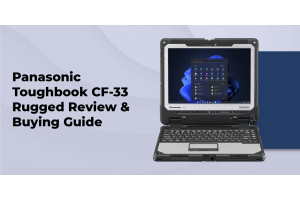
Air Force applications range from garrison intelligence analysis to flight-line crew chief work. For mobile field use, the TOUGHBOOK 33 2-in-1 fits well. Its 12-inch form factor is compact enough for confined cockpit and maintenance bay spaces, and the detachable keyboard lets it function as a tablet when a full keyboard is not needed. The device is drop-tested to 4 to 5 feet with the keyboard attached and carries IP65 protection for the dust and moisture exposure typical on the flight line.
The TOUGHBOOK 33 has been deployed in the USAF Mission Planning System (MPS) program, a collaborative Air Force initiative using rugged 2-in-1 devices for flight plan creation across aerial platforms. Devices used in that program must operate reliably in austere ground environments and on aerial platforms, a requirement the TOUGHBOOK 33 was purpose-built to meet. Its altitude testing extends to a simulated 50,000 feet, well beyond the MIL-STD-810H standard 15,000-foot requirement.
Special Operations and High-Security Roles
Special operations units and personnel handling classified material have requirements that go beyond physical ruggedness. These roles require FIPS 140-2 validated storage, CAC and PKI authentication support, and in many cases CMMC-aligned configurations for defense contractor integration. Toughbook models can be configured with FIPS 140-2 compliant storage modules. The fully sealed design and the option to remove all wireless radios, WiFi, Bluetooth, and cellular satisfy physical security requirements for handling sensitive compartmented information in environments where emissions discipline matters.
Procurement officers supporting special operations units should work directly with an authorized reseller to configure devices before purchase. Contact our team at ToughRuggedLaptops for configuration consultation.
Military Toughbook Models Compared
The current Toughbook lineup for military applications spans four primary models. Each addresses a different combination of ruggedness level, form factor, and mission flexibility.
|
Model |
Form Factor |
Drop Spec |
IP Rating |
Best For |
xPAK Slots |
|
TOUGHBOOK 40 |
14" Laptop |
6 ft |
IP65/66 |
Army field ops, vehicle command |
4+ |
|
TOUGHBOOK 55 |
14" Laptop |
3 ft |
IP65 |
Navy/AF maintenance, base ops |
3 |
|
TOUGHBOOK 33 |
12" 2-in-1 |
4-5 ft (w/ keyboard) |
IP65 |
AF flight line, compact field use |
2 |
|
TOUGHBOOK G2 |
10" Tablet 2-in-1 |
4 ft |
IP65 |
Handheld field reference, inspections |
3 |
All four models are MIL-STD-810H certified and TAA compliant. Primary decision drivers are screen size preference, required drop height, whether a convertible tablet form factor is needed, and how many modular expansion slots the mission requires.
Military Compliance Standards Every Toughbook Meets
Understanding which compliance requirements apply to a specific role is essential before any purchase decision. Toughbooks are engineered to address the full stack of standards that DoD procurement demands.
MIL-STD-810H
MIL-STD-810H is the U.S. Department of Defense environmental engineering standard covering 28 test methods. Operating temperature range on most current Toughbook models runs from -20°C to +60°C (-4°F to +140°F), with non-operating storage tested at more extreme ranges. Temperature cycling tests verify the device survives repeated transitions between air-conditioned vehicles and open outdoor environments relevant for any deployment that crosses climate zones in a single day.
Panasonic tests Toughbooks to MIL-STD-810H specifications and, in several cases, exceeds them. The TOUGHBOOK 33 and TOUGHBOOK 40, for example, are altitude-tested to a simulated 50,000 feet versus the standard 15,000-foot requirement.
TAA Compliance
The Trade Agreements Act requires U.S. government purchases to be manufactured in the United States or a TAA-designated country. All current Toughbook models are TAA compliant, a prerequisite for any DoD or federal civilian agency procurement. Non-TAA-compliant devices cannot be purchased using federal appropriated funds, which makes this the starting point for any acquisition conversation.
FIPS 140-2
Federal Information Processing Standard 140-2 specifies security requirements for cryptographic modules protecting sensitive but unclassified information. Toughbook models can be configured with FIPS 140-2 validated storage options, which is a mandatory requirement for many DoD roles involving controlled unclassified information (CUI) and is increasingly required in defense contractor environments under CMMC frameworks.
MIL-STD-461F and HERO Compliance
For deployments near electronic warfare systems, radar installations, or munitions, MIL-STD-461F electromagnetic compatibility compliance is required to prevent interference with military systems. In environments where electrically initiated devices are present, HERO (Hazards of Electromagnetic Radiation to Ordnance) compliance ensures the device does not inadvertently trigger munitions. Specific Toughbook configurations are available with full EMC compliance. Procurement officers supporting units operating in those environments should confirm EMC requirements before selecting a model.
CMMC Alignment for Defense Contractors
The Cybersecurity Maturity Model Certification framework applies to all defense contractors handling federal contract information or CUI. Toughbook devices deployed by defense contractors must support endpoint management, TPM-based trusted boot, and CAC and PKI authentication as part of a CMMC-aligned device configuration. Panasonic offers pre-configured deployment services that deliver Toughbooks ready for CMMC-relevant security baselines, reducing compliance overhead for contractor IT teams.
Key Features That Make Toughbooks Mission-Ready
Beyond certification compliance, specific hardware features distinguish Toughbooks from consumer and commercial rugged alternatives in actual field conditions.
- Modular xPAK expansion: User-replaceable expansion modules allow field-level addition of dedicated GPS receivers, barcode scanners, thermal imaging cameras, smartcard readers, and additional I/O ports without depot modification.
- Hot-swappable bridge battery: The bridge battery maintains system power during primary battery replacement, eliminating forced shutdowns during extended operations. The TOUGHBOOK 40 MK2 supports up to 36 hours of battery life with the extended configuration.
- Sunlight-readable display: Optional high-brightness panels up to 1,000 nit on select models provide readability in direct sunlight on flight lines, vehicle positions, and open terrain.
- Glove touch and rain mode: Capacitive touchscreens calibrated to respond to gloved input and reject false touches from rainwater — critical for operators in tactical gloves during wet conditions.
- Sealed port covers: Rubber-gasketed port doors prevent sand, dust, and moisture ingress at all I/O connections, which is the most consistent failure point on non-rugged and semi-rugged laptops in field use.
- ATAK and WinTAK compatibility: All current Toughbook laptops and tablets run standard Windows and Android operating systems, making them fully compatible with ATAK and WinTAK applications used for situational awareness and mission coordination.
- Land Mobile Radio (LMR) support: The TOUGHBOOK N1 Tactical handheld integrates LMR device support for units operating on legacy radio networks alongside digital systems.
- Dedicated AI processing: The TOUGHBOOK 40 MK2 includes a dedicated AI chip for edge processing — collecting, storing, and analyzing data using AI without requiring cloud connectivity, which matters in communications-contested environments.
- Red Hat Enterprise Linux certification: For defense and critical infrastructure customers running RHEL, current Toughbook models are certified — enabling interoperability without extended validation processes.
Total Cost of Ownership: Why Toughbooks Save Military Budgets
The upfront price of a Toughbook is higher than that of a commercial laptop. That is the most common objection raised in military procurement discussions, and it is the wrong metric for the decision.
According to an IDC white paper sponsored by Panasonic, Toughbook deployments generate TCO savings of up to 15% over five years compared to commercial laptop alternatives.
The savings come from three sources: lower failure rates, longer service life, and reduced depot maintenance costs.
Panasonic's service data shows an annual failure rate of approximately 2 percent for Toughbook devices in active deployment. Industry average failure rates for standard laptops run between 11 and 15 percent. In a fleet of 100 devices over five years, that difference eliminates roughly 65 replacement and repair events, each carrying parts and labor costs, operational downtime, and data continuity risk that commercial procurement models rarely quantify.
A Toughbook is typically fielded for 5 to 7 years before replacement, compared to 2 to 3 years for commercial devices in equivalent environments. The modular xPAK design extends usable life further by allowing hardware upgrades without chassis replacement, a meaningful advantage for budget planners working under constrained procurement cycles.
For military budget planners, the lifecycle cost argument for Toughbooks is supported by field data. For a detailed TCO comparison for your specific fleet size, reach out to our team at ToughRuggedLaptops.
How to Buy a Military Toughbook: GSA Schedule and DoD Options
Military units and defense contractors have several acquisition pathways for Toughbook devices. The right vehicle depends on acquisition timeline, contracting requirements, and fleet size.
- GSA Multiple Award Schedule (MAS): The fastest route for most federal and military buyers. Panasonic Toughbooks are available on GSA MAS IT Schedule 70. TAA compliance is pre-verified at the schedule level, simplifying contracting officer review and reducing acquisition lead time.
- GSA Advantage AdvantageSelect: For standard Toughbook configurations, pre-competed BPA pricing is available with no further competition required — the most efficient option for routine fleet purchases.
- BPA Call Orders: Agencies with established Blanket Purchase Agreements can issue call orders directly against existing BPA vehicles, further reducing acquisition lead time.
- IDIQ Contracts: Larger fleet procurements or contracts requiring custom configurations can use Indefinite Delivery/Indefinite Quantity vehicles. Panasonic and authorized resellers hold positions on multiple DoD IDIQ vehicles.
- Defense contractor purchases: Contractors purchasing Toughbooks for use on DoD programs should work with a TAA-compliant authorized reseller and confirm CMMC configuration requirements before order placement.
ToughRuggedLaptops.com is a Panasonic-authorized Toughbook reseller. We can quote against your unit's GSA Schedule, existing BPA, or IDIQ vehicle. Contact us at 800-441-9165 or request a free quote online
FAQs
1. Does the military use ToughBooks?
Yes. Panasonic ToughBooks are widely used across all U.S. military branches for field operations, vehicle systems, maintenance, and logistics due to their rugged design and TAA compliance.
2. What laptops does the U.S. military use?
The military uses various devices, but Panasonic ToughBooks are among the most common rugged platforms for field deployments. Office roles often use standard business laptops.
3. What does “military grade” mean in laptops?
It means the laptop has passed MIL-STD-810H testing for drops, vibration, temperature extremes, dust, humidity, and water resistance.
4. What is the lifespan of a ToughBook?
Most ToughBooks last 5–7 years in active field use, with lower failure rates than standard laptops.
5. How often are ToughBooks replaced?
Military and government agencies typically replace them every 5–7 years due to software updates, performance needs, or wear.
6. Can a ToughBook handle extreme temperatures?
Yes. Most models operate between -20°C and +60°C and are tested for repeated temperature changes.
7. What laptop do Navy SEALs use?
Specific devices are not publicly disclosed, but special operations units are known to use Panasonic ToughBooks in rugged deployments.
8. Is the ToughBook 40 MK2 different from the original ToughBook 40?
Yes. The MK2 is lighter, upgraded to IP66 protection, adds AI processing capabilities, and supports newer Intel Core Ultra processors while remaining compatible with existing docks and mounts.
The Right Device for the Right Mission: We Can Help You Find It
Matching the wrong Toughbook to a mission profile is an expensive mistake. Matching the right one, configured correctly for the branch, role, and compliance requirement, means a device that works every time it needs to for the next six years.
We have been placing Toughbooks into military units, first responder agencies, and defense contractors for years. Our product specialists know the compliance requirements, the GSA Schedule process, and the mission-specific configurations that procurement generalists often miss. If you know what model you need, we can quote it. If you are still deciding, we can help you make the right call.
Request a free, no-obligation quote at ToughRuggedLaptops.com or call us directly at 800-441-9165. We quote against GSA Schedule, BPA vehicles, and IDIQ contracts and can configure any Toughbook to your exact mission requirements.