Rugged Laptops for Emergency Services- The Complete Procurement Guide for US Agencies
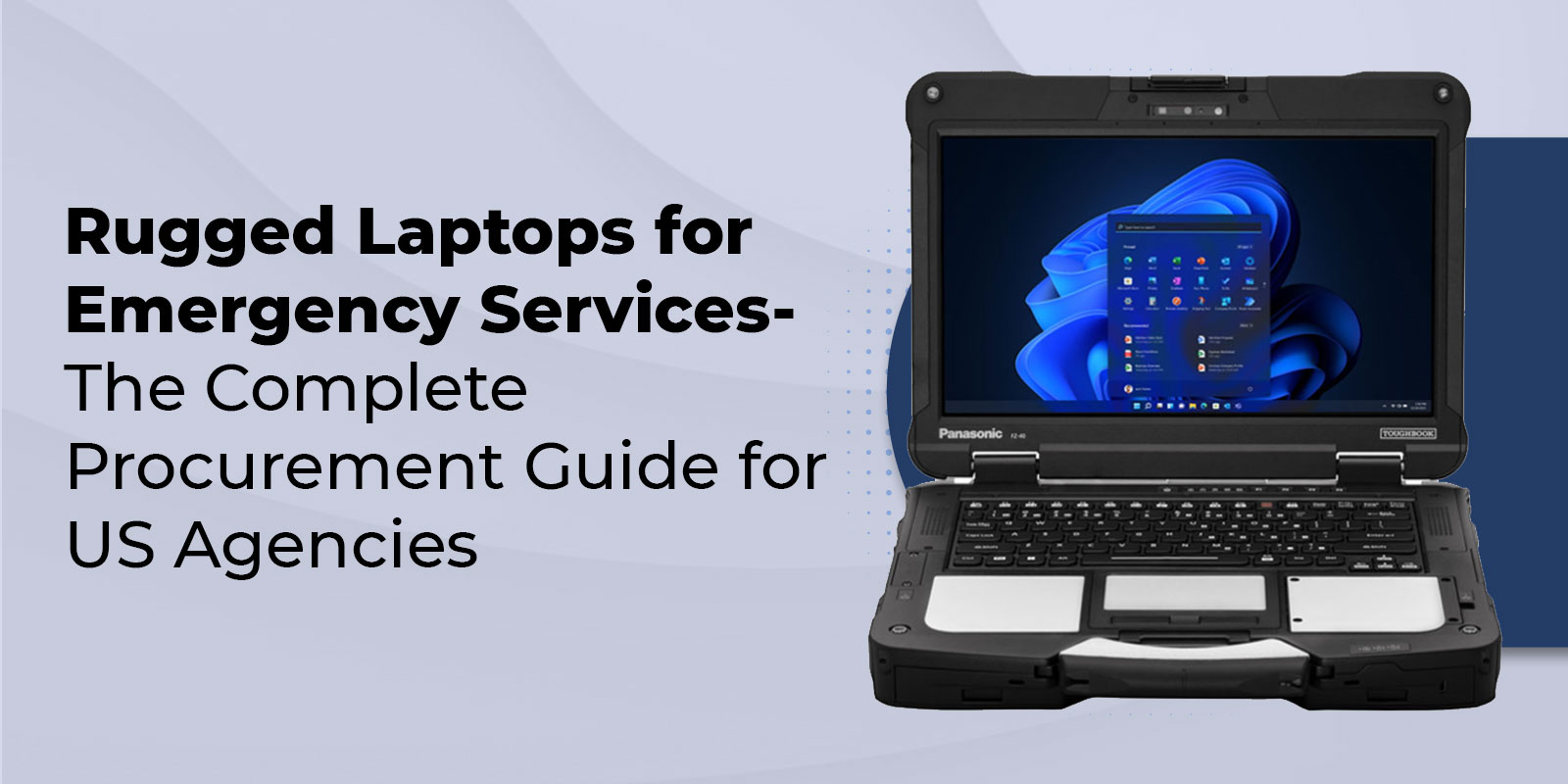
Rugged laptops for emergency services are mobile computers built to MIL-STD-810H and IP65 standards, so they keep working through drops, vibration, temperature extremes, water, and dust. They are the standard field platform for US police, fire, EMS, and search-and-rescue agencies that need reliable access to dispatch, mapping, and patient records.
What makes a laptop rugged for emergency services use?
A consumer laptop is built for office life. A rugged laptop is built to keep running when it is dropped from a moving ambulance, soaked at a brushfire, or operated at 145 degrees Fahrenheit inside a patrol car parked in August sun. The difference is structural- a magnesium alloy chassis instead of plastic, shock-mounted storage instead of standard SSDs, sealed ports and gaskets instead of open vents, and sunlight-readable displays that stay legible above 1,000 nits in direct sunlight.
For an emergency services deployment, three classes of ruggedness matter. Business-rugged laptops handle the bumps of a service vehicle but should not be used as field devices. Semi-rugged laptops survive most field conditions short of submersion or sustained vehicle vibration. Fully rugged laptops are the only class certified to withstand the full duty cycle of a frontline patrol, fire, or EMS vehicle, and they are the only class that typically qualifies under federal grant bid specifications.
Critical certifications- MIL-STD-810H, MIL-STD-461G, and IP ratings
Three independent test standards define what qualifies as a rugged laptop on an agency procurement specification.
MIL-STD-810H is the US Department of Defense test method standard for environmental engineering. A laptop certified to 810H has passed laboratory testing for drops up to six feet, vibration profiles consistent with vehicle mounting, operating temperatures from minus 20 to 145 degrees Fahrenheit, altitude, salt fog, and driving rain. Procurement specifications should require 810H, not the older 810G revision, which is still cited on some legacy product sheets.
MIL-STD-461G governs electromagnetic compatibility. A device that meets 461G will not interfere with or disrupt the radios, mobile data terminals, lightbars, and antennas already installed in an emergency vehicle. This certification matters most for patrol and fire apparatus where the laptop shares a vehicle bus with public safety radios.
IP ratings describe ingress protection. IP65 means dust-tight and protected against low-pressure water jets. IP66 protects against powerful water jets, which is the realistic standard for fire and search-and-rescue applications. The rating belongs on the spec sheet, not in marketing language- if a vendor cannot cite the specific IP rating, treat the device as uncertified.
The top rugged laptop platforms for US emergency services
Four manufacturers dominate the US public safety market. Each fills a different role, and the right choice depends on the operating environment, the vehicle fleet, and the agency budget.
Panasonic Toughbook
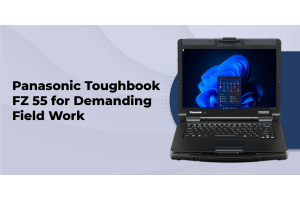
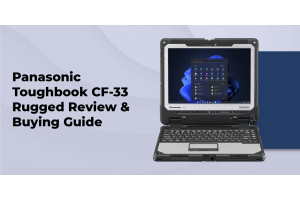
The Panasonic Toughbook 40 and Toughbook 56 are the workhorses of US public safety. The Toughbook 40 offers modular expansion bays that an agency can configure for serial ports, smart card readers, or thermal cameras. The Toughbook 33 is a detachable 2-in-1 popular with EMS for inside-the-ambulance ePCR documentation, and the Toughbook G2 is a 10-inch tablet used by detectives and supervisors who need a smaller form factor. Hot-swap dual batteries deliver up to 41 hours of runtime, which covers a single 24-hour station rotation without an external charge.
Dell Rugged
The Dell Pro Rugged 13 and 14 (formerly the Latitude 5430 Rugged and 7330 Rugged Extreme) are strong picks for agencies already standardized on Dell elsewhere in their IT stack. The line operates from minus 20 to 145 degrees Fahrenheit, integrates cleanly with Dell remote management tools, and offers competitive battery runtime for in-vehicle deployments.
Getac
The Getac B360 is a lightweight, fully rugged laptop favored by patrol officers who frequently carry it between vehicles and incident scenes. Getac's LumiBond display technology keeps the screen readable even with wet gloves and in rain, a meaningful advantage during traffic enforcement and outdoor incident command. The S510 is the larger 15.6-inch option for command vehicles and mobile command posts.
Durabook
The Durabook S14I and S15 deliver fully rugged construction at a lower price point than the Toughbook and Dell Pro Rugged lines. Durabook is the practical choice for volunteer fire departments and smaller EMS agencies operating under tight equipment budgets while still requiring full MIL-STD-810H and IP65 certification on the bid specification.
Use cases by agency type.
A patrol officer, a paramedic, and a wildland firefighter use the same general device category very differently. Specifying a rugged laptop correctly starts with matching the configuration to the mission.
Police and law enforcement
Patrol vehicles run a rugged laptop as the in-vehicle mobile data terminal connected to dispatch, the agency's Computer-Aided Dispatch (CAD) platform, the state criminal justice information system, and the in-car video system. Specifications typically require Smart Card or Common Access Card reader integration for CJIS-compliant authentication, a sunlight-readable display for traffic enforcement work, and a vehicle dock with port replication.
Fire and rescue
Fire apparatus computers run pre-incident planning software, hydrant location databases, and hazardous materials reference data. Specifications should require IP66 ingress protection, as fire pump panels and engine compartments expose the device to water and debris beyond normal patrol conditions. Glove-compatible touchscreens are non-negotiable for crews wearing structural firefighting gear.
EMS and paramedics
Ambulance computers run ePCR software during patient transport, then sync with hospital systems on arrival. The device must be both fully rugged and easy to disinfect, since cleaning protocols use isopropyl alcohol or quaternary ammonium sprays between calls. Hot-swap batteries are critical for 24-hour station coverage when there is no opportunity to power down the device for charging.
Search and rescue and disaster response
SAR and disaster response teams need devices that operate disconnected from cell coverage, so satellite connectivity, offline mapping, and extended-range Wi-Fi become priorities. A battery runtime of 14 hours or more is the minimum requirement for incident command posts during multi-day deployments, and an extended-life battery option is worth specifying.
ePCR, CAD, and RMS software compatibility
A rugged laptop is only as useful as the software it runs. Four software categories dominate the emergency services stack, and OEM compatibility varies in ways that buyer specifications often miss.
For EMS, the leading ePCR platforms are ImageTrend Elite, ESO Electronic Health Record, and ZOLL EMSCharts. All three are NEMSIS Gold-compliant and run natively on Windows 10 and Windows 11 Pro, making any current Panasonic Toughbook, Dell Pro Rugged, Getac, or Durabook a viable host. Verify that the configured device meets the published vendor minimum spec, typically 16 GB of RAM, a 256 GB or larger SSD, and a Full HD display.
For police, the dominant CAD and Records Management Systems (RMS) platforms are CentralSquare Public Safety, Tyler Technologies Enforcement Mobile, and Hexagon OnCall Records. These run on Windows but typically require specific Microsoft .NET, TLS, and Windows update configurations that should be confirmed against the device build before fleet rollout.
For fire and rescue, ESO Fire RMS, FirstNet Push-to-Talk, and the National Fire Incident Reporting System (NFIRS) reporting tools should be tested against the device build. Agencies running 5G or FirstNet Band 14 deployments should specify devices with the corresponding modem certifications, since not every modem SKU is approved on every carrier.
CJIS and HIPAA compliance for agency data
Two federal data standards govern most emergency services laptop deployments, and both flow through to hardware specification.
CJIS, the FBI Criminal Justice Information Services Security Policy, applies to any device that accesses NCIC, state criminal histories, or other criminal justice information. CJIS requires advanced authentication, encryption at rest, audit logging, and physical security controls. In practice, this means a TPM 2.0 module, FIPS 140-2 or FIPS 140-3 validated full-disk encryption, and a second authentication factor such as a Common Access Card reader or fingerprint sensor. A patrol laptop specification should require all three.
HIPAA governs the protected health information that EMS captures in an ePCR. While HIPAA does not certify hardware, the Security Rule requires technical safeguards equivalent to CJIS requirements, including encryption, access control, audit logs, and automatic logoff. An EMS specification should match those controls and add remote wipe capability through a mobile device management platform, so that a lost or stolen ambulance laptop does not leak patient data.
A practical rule for procurement- if any device in the fleet ever touches both CJIS data and HIPAA data, build to the higher of the two standards across the entire fleet. It keeps audit, configuration, and training manageable and removes a class of compliance failures that arise from running mixed-device builds.
How to fund the purchase- grants and cooperative contracts
Most US agencies do not buy rugged laptops with operating budget funds. Four funding pathways dominate.
The Assistance to Firefighters Grants (AFG) program, administered by FEMA, funds equipment for career and volunteer fire departments and non-affiliated EMS organizations. AFG requires a non-federal cost share of 5 to 15 percent, depending on agency size, an active SAM.gov registration, and a detailed bid specification that often references the MIL-STD and IP ratings discussed above. The FY2025 AFG cycle awarded roughly 291 million dollars in equipment grants across approximately 2,000 awards.
SAFER, the Staffing for Adequate Fire and Emergency Response grant, primarily funds personnel but can include the equipment those personnel require. The Homeland Security Grant Program (HSGP) funds counter-terrorism and disaster preparedness equipment, including rugged computing for incident command and mass-casualty response. State Homeland Security Program allocations under HSGP frequently cover police and SAR equipment.
GSA Schedule (now Multiple Award Schedule IT) is the federal cooperative-contract pathway that lets eligible agencies purchase from pre-negotiated federal pricing without running an independent bid. NASPO ValuePoint provides the same shortcut at the state and local level. Both pathways are worth the time it takes to verify eligibility, since they typically compress a procurement cycle from months to weeks.
Total cost of ownership over a five-year deployment cycle
Acquisition cost is roughly half of what an agency actually spends on a rugged laptop fleet over five years. Procurement officers who plan only for the sticker price typically underbudget the program by 40-60%.
A full TCO model should include- device acquisition (laptop, dock or mount, charger, vehicle power kit), vehicle integration labor, software licensing for ePCR or CAD plus mobile device management and endpoint security, connectivity (cellular or FirstNet data plans), accidental damage protection or extended warranty, mid-cycle battery replacement at year three, a repair pool sized at roughly one spare per ten production units, training, and end-of-life refresh or disposition.
A useful planning rule for a five-year cycle on a fully rugged platform is to budget 1.6 to 1.8 times the device acquisition cost for total program cost. For a 4,500-dollar fully configured Toughbook 40 seat with dock and accidental damage coverage, that is roughly 7,200 to 8,100 dollars per device over the cycle. Refurbished units lower acquisition cost by 40 to 60 percent and remain warranty-eligible through specialty channels, which is the dominant approach for budget-constrained departments.
How to choose- a decision framework by agency size and mission
Match the agency profile to the platform tier first, then validate the specific configuration against your software vendor's published minimum spec. The framework below is a starting point.
|
Agency profile |
Recommended platform tier |
Form factor |
RAM / Storage |
Critical specs to require |
|---|---|---|---|---|
|
Metropolitan police, 500+ units |
Toughbook 40, Toughbook 56, Dell Pro Rugged 14 |
14-inch vehicle-docked |
16 GB / 512 GB |
CJIS, TPM 2.0, CAC reader, hot-swap battery |
|
Suburban or county police, 50–500 units |
Toughbook 55, Getac B360, Dell Pro Rugged 13 |
13–14-inch laptop |
16 GB / 256 GB |
CJIS, TPM 2.0, sunlight-readable |
|
Rural patrol or sheriff, under 50 |
Refurbished Toughbook 55, Durabook S14I |
13–14-inch laptop |
16 GB / 256 GB |
CJIS, TPM 2.0, AFG-compliant spec |
|
Metropolitan fire/EMS, 100+ apparatus |
Toughbook 40, Toughbook 33 (EMS) |
14-inch laptop and detachable 2-in-1 |
16 GB / 256 GB |
IP66, HIPAA-aligned, hot-swap battery |
|
Volunteer fire, under 25 apparatus |
Refurbished Toughbook 33, Durabook S14I |
12–14-inch detachable or laptop |
16 GB / 256 GB |
IP66, AFG-compliant bid spec |
|
Search and rescue/disaster response |
Toughbook 40 + satellite, Getac S510 |
14–15.6-inch laptop |
16 GB / 512 GB |
Extended battery, satellite-ready, offline mapping |
|
EMS, hospital-affiliated |
Toughbook 33, Dell Pro Rugged 13 |
12–13-inch detachable |
16 GB / 256 GB |
IP65 minimum, hot-swap battery, NEMSIS-compliant ePCR |
Final configurations should be validated against the specific ePCR, CAD, or RMS vendor specification in use, the in-vehicle dock standard already deployed in the fleet, and any active federal or state grant bid specification. The Rugged Computing sales team at ToughRuggedLaptops can validate any of these scenarios on request through the " Request a quote workflow.
Frequently asked questions
1. What makes a laptop rugged?
A rugged laptop features a magnesium-alloy chassis, shock-mounted storage, sealed ports, and gasketed displays. Hence, it survives drops, vibration, water, dust, and temperature extremes that destroy consumer laptops. It is then certified to test standards such as MIL-STD-810H and IP65 or IP66 to verify that protection in laboratory conditions.
2. What certifications should a rugged laptop for emergency services have?
The procurement standard is MIL-STD-810H for environmental durability, MIL-STD-461G for electromagnetic compatibility in vehicles with radios, and IP65 or IP66 for dust and water protection. Law enforcement specifications add TPM 2.0 and FIPS 140-2 or 140-3 validated encryption to meet CJIS Security Policy requirements for accessing criminal justice data.
3. How do rugged laptops differ from regular laptops?
Rugged laptops use magnesium alloy chassis instead of plastic, shock-mounted SSDs, sealed ports, sunlight-readable displays exceeding 1,000 nits, and hot-swap dual batteries. They cost three to four times as much as consumer laptops but last twice as long in field use, with manufacturer failure rates around 2.4 percent, versus a 7 percent industry average.
4. What ePCR and CAD software run on rugged laptops?
The leading EMS ePCR platforms, ImageTrend Elite, ESO Electronic Health Record, and ZOLL EMSCharts, all run natively on Windows 10 and 11 Pro, which means any current Panasonic Toughbook, Dell Pro Rugged, Getac, or Durabook is a supported host. Police CAD platforms CentralSquare, Tyler Enforcement Mobile, and Hexagon OnCall are similarly Windows-based.
5. Are rugged laptops CJIS-compliant for law enforcement?
Rugged laptops are the standard hardware platform for CJIS-compliant patrol deployments. To meet CJIS Security Policy requirements, the device must include a TPM 2.0 module, FIPS 140-2 or 140-3 validated full-disk encryption, and a second authentication factor such as a Common Access Card reader or fingerprint sensor. Compliance is configuration-dependent, not automatic.
6. Can rugged laptops be purchased with FEMA AFG grant funding?
Yes. The Assistance to Firefighters Grants program regularly funds rugged laptops as equipment for fire departments and non-affiliated EMS organizations. AFG requires a 5 to 15 percent non-federal cost share, an active SAM.gov registration, and a written bid specification referencing MIL-STD-810H and IP rating thresholds. The FY2025 cycle awarded approximately $ 291 million.
7. What is the total cost of ownership for a rugged laptop fleet over five years?
A five-year fully loaded TCO is roughly 1.6 to 1.8 times the device acquisition cost, including vehicle dock and mount, software licensing, cellular data, accidental damage coverage, mid-cycle battery replacement, repair pool, and end-of-life refresh. For a 4,500-dollar rugged laptop seat, plan 7,200 to 8,100 dollars per device over the cycle.
8. How long do rugged laptops last in emergencies?
A fully rugged laptop in 24-hour vehicle service typically delivers 5 to 7 years of useful life before refresh, compared to 2 to 3 years for a consumer laptop in the same role. Battery replacement is required around year three. Refurbished units can re-enter service for 3 to 4 additional years with proper screening.
Get a configured quote for your agency
ToughRuggedLaptops (Rugged Computing, Inc.) has been deploying configured rugged laptops to US emergency services, military, and field agencies for over 20 years. Our team will validate your bid specification against your active ePCR, CAD, or RMS platform, confirm compatibility with your in-vehicle dock standard, and configure it for CJIS or HIPAA controls before the device ships. Call 800-441-9165 or request a quote online. Refurbished options and lifetime tech support are available on every purchase.