Panasonic TOUGHBOOK FZ-56: Complete Specs, xPAK Guide & Field Buyer Review
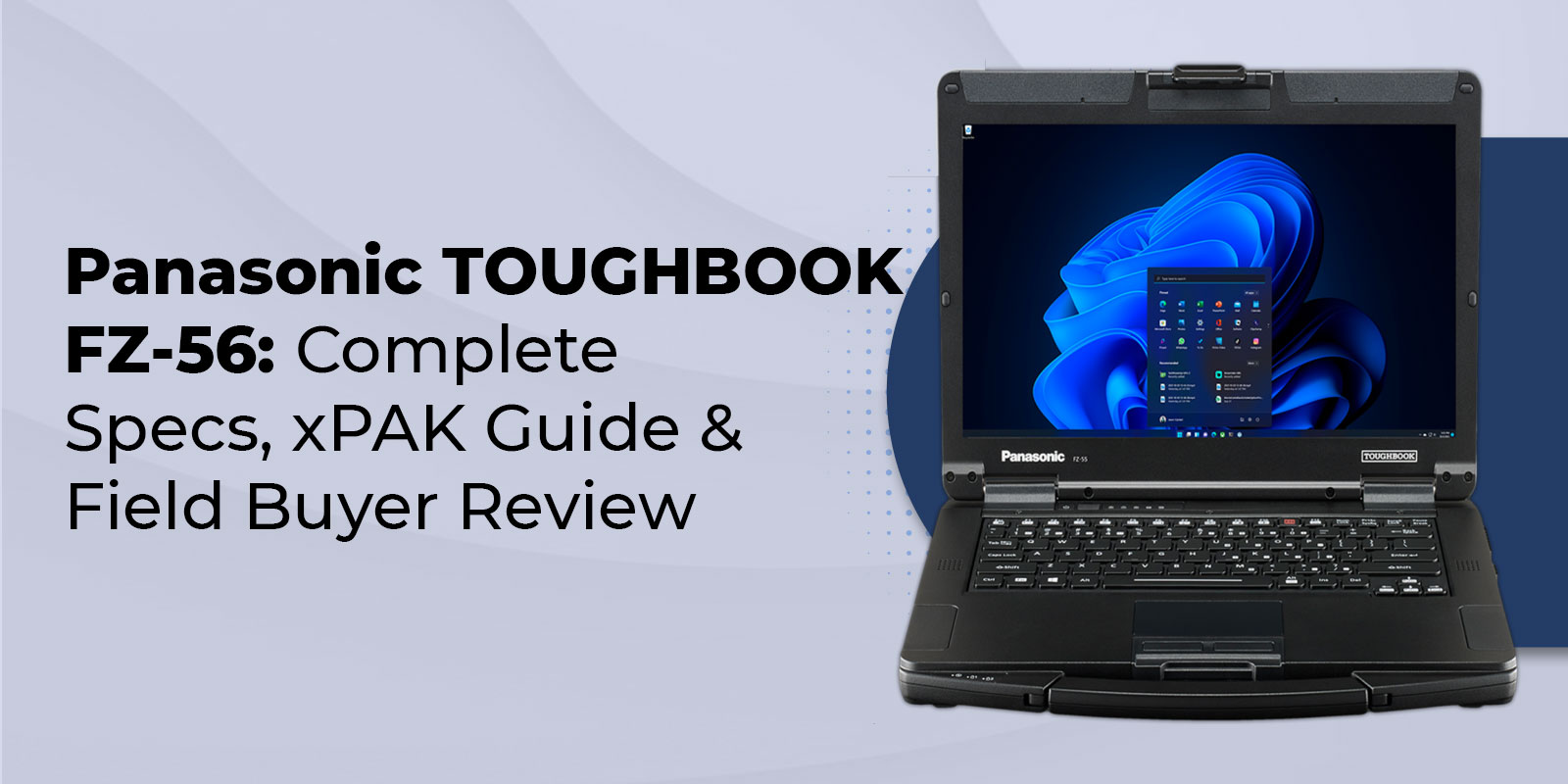
The Panasonic TOUGHBOOK FZ-56 is a 14-inch semi-rugged laptop designed for field professionals in law enforcement, utilities, construction, and defense. It runs on Intel Core Ultra processors with an optional 8GB discrete GPU, supports up to 24 hours of hot-swappable battery life, and features six modular xPAK expansion areas for role-specific hardware configurations.
What Is the Panasonic TOUGHBOOK FZ-56?
The TOUGHBOOK FZ-56 is Panasonic's newest semi-rugged laptop, announced in March 2026 and shipping in May 2026. It replaces the widely deployed FZ-55 and introduces a redesigned chassis, next-generation Intel Core Ultra 200H processors, and a fully revised modular architecture built around three xPAK expansion slots plus three additional user-replaceable areas for battery, RAM, and storage.
At its core, the FZ-56 is built for mission-critical professionals who cannot afford downtime. The reinforced magnesium alloy chassis meets MIL-STD-810H standards across 14 test categories, including 3-foot drop resistance, shock, vibration, extreme temperature operation, and fluid contamination resistance. Combined with an IP53 ingress protection rating and MIL-STD-461G electromagnetic interference certification, the FZ-56 is designed to operate in environments where standard business laptops would fail.
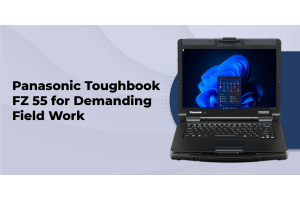
The device runs Windows 11 Pro as standard, with Red Hat Enterprise Linux 10.1 also supported, making it one of the few rugged laptops certified for Linux in mission-critical IT environments. A 3-year limited warranty covering parts and labor is included with every unit.
FZ-56 Full Specs and Technical Breakdown
|
Specification |
Detail |
|
Model |
Panasonic TOUGHBOOK FZ-56 (FZ-56) |
|
CPU Options |
Intel Core Ultra 5 235H vPro (up to 5.0GHz, 14 cores) | Intel Core Ultra 7 265H vPro (up to 5.3GHz, 16 cores) |
|
GPU |
Intel integrated (standard) | AMD Radeon Pro W7500M 8GB GDDR6 dGPU (optional) |
|
AI Performance |
Up to 97 TOPS (integrated) | 34.5 TOPS with 8GB dGPU | 56 AI Accelerators |
|
RAM |
16GB DDR5 standard | up to 64GB DDR5 |
|
Storage |
512GB OPAL SSD standard | FIPS encrypted SSD option available |
|
Display |
14.0-inch 16:10 WUXGA (1920x1200) | 350-nit standard | 1000-nit gloved multi-touch option |
|
Display Protection |
Corning Gorilla Glass 3 | raised bezel | replaceable screen protector |
|
Battery |
Standard: 12 hours (MobileMark 30) | Dual hot-swap: up to 24 hours |
|
Operating System |
Windows 11 Pro | Red Hat Enterprise Linux 10.1 |
|
Durability |
MIL-STD-810H | MIL-STD-461G | IP53 | 3-foot drop protection |
|
Weight |
4.66 lbs (standard) | 4.99 lbs (touch model) |
|
Dimensions |
36.3mm thin (standard chassis) |
|
Wireless |
Wi-Fi 7 | Bluetooth 5.4 | optional 5G (Sub6+C-band, up to 3.5Gbps) | optional 4G LTE-A |
|
Cellular Standards |
FirstNet (Band 14) | Private Cellular CBRS (Band 48) | Dual SIM (physical + eSIM) |
|
Ports (standard) |
Thunderbolt 4 USB-C x2 | USB-A (up to 2) | HDMI | 1Gbps Ethernet | MicroSDXC | Audio in/out | Dual SIM | Docking Connector |
|
Ports (xPAK) |
10Gbps Ethernet | 2.5Gbps Ethernet | True Serial | VGA | additional USB-A | DVD | Blu-ray |
|
Security |
OPAL SSD standard | FIPS SSD optional | TPM 2.0 | TOUGHBOOK Total Defense | TOUGHBOOK Guard (supply chain) |
|
Warranty |
3-year limited, parts and labor |
|
Dock Compatibility |
Backwards compatible with most TOUGHBOOK FZ-55 vehicle docks |
xPAK Modular System Explained
The xPAK system is one of the most important and least-understood features of the FZ-56. Where most rugged laptops offer fixed hardware configurations, the FZ-56 features three dedicated xPAK expansion slots plus three additional user-replaceable areas, giving organizations up to 5,760 possible configurations from a single base unit.
Each xPAK is a hot-swappable modular insert that slides into one of three dedicated slots on the chassis. This means your IT team can reconfigure a device for a different role without sending it back to a depot or purchasing a new unit. A patrol officer's laptop configured with a barcode reader and fingerprint reader today can be reconfigured with an optical drive and a second battery for a field technician tomorrow.
Available xPAK Modules
|
xPAK Module |
Primary Use Case |
Industries |
|
Barcode Reader |
Asset tracking, inventory management, evidence scanning |
Law Enforcement, Warehousing, Healthcare |
|
Optical Drive (DVD / Blu-ray) |
Software deployment, media playback, secure data transfer |
Military, Government, Field Services |
|
Smart Card Reader (insertable) |
PKI authentication, CAC card access, secure login |
Military, Federal Government, Healthcare |
|
Contactless Smart Card / NFC Reader |
Access control, patient ID, mobile payments |
Healthcare, Retail, Public Safety |
|
Fingerprint Reader |
Biometric authentication, secure login without a password |
Law Enforcement, Military, Enterprise |
|
Second Battery Pack |
24-hour continuous operation without AC access |
Utilities, Construction, EMS, Military |
|
10Gbps Ethernet xPAK |
High-speed imaging, large file transfers, and in-vehicle networking |
Law Enforcement, Fire, EMS |
|
2.5Gbps Ethernet xPAK |
Fast wired connectivity in field offices or command centers |
Military, Government, Field Services |
|
FIPS Encrypted SSD |
NIST-compliant data storage for classified environments |
Military, Federal Government, Intelligence |
|
True Serial Port |
Legacy equipment integration, industrial control systems |
Utilities, Manufacturing, Transportation |
The three non-xPAK user-replaceable areas cover RAM (expandable to 64GB DDR5), primary SSD storage, and the main battery. Combined with the xPAK slots, this architecture allows a single procurement order to cover multiple operational roles across a fleet, reducing per-unit costs and simplifying spare parts management.
FZ-56 vs FZ-55: Should You Upgrade?
If your organization currently runs a fleet of FZ-55 units, the upgrade decision comes down to three factors: processing requirements, connectivity needs, and whether your use case can benefit from AI-edge computing or discrete GPU performance.
|
Feature |
FZ-55 MK3 |
FZ-56 |
Upgrade Benefit |
|
CPU |
Intel Core i7-1370P (13th Gen) |
Intel Core Ultra 7 265H (Series 2) |
Higher single-core and multi-core performance; dedicated NPU for AI tasks |
|
GPU |
Integrated Intel Iris Xe |
Optional AMD Radeon Pro W7500M 8GB GDDR6 |
First rugged laptop with 8GB dGPU; enables AI inference and GIS rendering |
|
Display |
14-inch FHD (1920x1080) |
14-inch 16:10 WUXGA (1920x1200) |
More vertical screen space; useful for field data, maps, technical manuals |
|
RAM |
Up to 64GB DDR4 |
Up to 64GB DDR5 |
Faster memory bus; better performance with AI and analytics workloads |
|
Wi-Fi |
Wi-Fi 6 (802.11ax) |
Wi-Fi 7 (802.11be) |
2.4x faster wireless; lower latency in congested environments |
|
5G Modem |
5G option available |
Improved 5G modem (36% faster); FirstNet + CBRS + eSIM |
Better carrier flexibility; faster downloads in the field |
|
Battery |
Up to 20 hours (dual) |
Up to 24 hours (dual, MobileMark 30) |
Four more hours per shift cycle |
|
Chassis |
Standard magnesium |
Redesigned ErgoGrip with retractable handle |
Reduced carry fatigue; one-hand screen opening with gloves |
|
Dock Compatibility |
FZ-55 docks |
Backwards compatible with most FZ-55 vehicle docks |
Fleet upgrade without replacing vehicle dock infrastructure |
|
Security |
OPAL SSD option |
OPAL standard + FIPS option + TOUGHBOOK Guard |
Full supply chain tamper detection; stronger government compliance posture |
|
AI TOPS |
Not applicable |
Up to 97 TOPS (34.5 with dGPU) |
Enables local AI inference without cloud dependency |
|
Weight |
4.37 lbs |
4.66 lbs (standard) |
Slightly heavier due to the revised chassis and ErgoGrip handle |
For organizations that do not require AI-edge computing, the optional dGPU, or FIPS-level encryption, the FZ-55 MK3 remains a capable and cost-effective option. For any deployment that involves AI-assisted data analysis, high-resolution mapping, classified data handling, or requires a longer battery runway per shift, the FZ-56 represents a meaningful operational improvement.
The backwards compatibility with most FZ-55 vehicle docks is a significant operational advantage. Fleet managers can phase in FZ-56 units without triggering a full vehicle dock replacement cycle, protecting existing infrastructure investment.
Who Should Buy the FZ-56: Industry Use Cases
The FZ-56 is not a one-size-fits-all device. Its modular architecture is specifically designed to serve different operational roles across industries. The following breakdown maps the FZ-56 to the industries and workflows where it provides the highest operational return.
Law Enforcement and Public Safety
Law enforcement agencies require devices that operate reliably in vehicles, at crime scenes, and during active incidents. The FZ-56 supports FirstNet (Band 14) cellular connectivity, which is the dedicated wireless network for first responders. Combined with the fingerprint reader xPAK for secure login without removing gloves, the 1000-nit sunlight-viewable display, and MIL-STD-461G EMI certification, the FZ-56 is designed for in-vehicle and on-scene deployment. The barcode reader xPAK supports evidence chain-of-custody scanning and vehicle inventory management.
Utilities and Energy
Field technicians in utilities work in environments with vibration, dust, moisture, and extreme temperatures. The FZ-56's IP53 rating and MIL-STD-810H certification cover the environmental conditions typical of substation, pipeline, and grid maintenance work. The True Serial xPAK enables direct connection to legacy industrial control system equipment. Wi-Fi 7 and the optional 5G modem with CBRS Private Cellular support keep technicians connected at remote sites or within private cellular network coverage areas.
Construction and Infrastructure
Construction environments demand portability as well as durability. The FZ-56's ErgoGrip retractable handle and 4.66-pound weight make it practical to carry across active job sites. The 16:10 WUXGA display provides additional vertical screen space for reviewing construction drawings, BIM models, and inspection reports in the field. The optional dGPU makes the FZ-56 one of the few rugged laptops capable of running graphics-intensive CAD and GIS applications directly at the edge without cloud dependency.
Defense and Military
Military deployments require FIPS-level data security, EMI compliance, and supply chain integrity. The FZ-56 is the only rugged laptop with an available FIPS encrypted SSD option and is MIL-STD-461G certified for electromagnetic interference resistance. TOUGHBOOK Guard provides supply chain security by detecting hardware tampering before the device is deployed. TAA compliance and Red Hat Enterprise Linux 10.1 support expand its eligibility for federal procurement vehicles. The 10Gbps Ethernet xPAK supports high-speed imaging and data transfer in tactical operations centers.
EMS and Healthcare
EMS providers and mobile healthcare workers need devices that can be cleaned, secured with biometrics, and operated with gloves. The FZ-56's Auto Touch Mode on the optional touchscreen automatically detects fingers, gloves, and pen input without requiring manual mode switching. The contactless smart card reader xPAK supports patient ID and access control. IP53 protection allows for surface cleaning in clinical environments. The 24-hour hot-swap battery ensures continuous operation across long shifts without requiring AC access.
AI Performance and the 8GB dGPU Advantage
The FZ-56 is the first rugged laptop to offer an 8GB discrete GPU option. This is not a feature aimed at gaming or general graphics work. It addresses a specific operational gap: the growing need to run AI inference models, large-scale geospatial analysis, and video analytics directly at the field edge, without sending data to the cloud.
The standard FZ-56 processor configuration already includes Intel AI Boost, a dedicated NPU that accelerates AI workloads independently of the CPU and integrated GPU. In this configuration, the device can perform up to 97 TOPS (Tera Operations Per Second), sufficient for AI-assisted threat detection, predictive maintenance algorithms, and natural language processing applications.
When equipped with the AMD Radeon Pro W7500M discrete GPU with 8GB of GDDR6 memory, the FZ-56 can perform 34.5 TOPS with 17 TFLOPS of peak FP32 floating-point performance. The Radiance Display Engine enables precise visual rendering across the 16:10 WUXGA display. This configuration is suited to organizations running GIS mapping applications, high-resolution video analysis, AI-powered surveillance review, or engineering simulation software in the field.
Note that the dGPU configuration is not compatible with vehicle docks and does not include a docking connector. Organizations planning to use the FZ-56 in vehicle dock configurations should select the standard integrated GPU model.
Security and Compliance for Enterprise Buyers
The FZ-56 includes the most comprehensive security feature set Panasonic has offered in a semi-rugged device. Every unit ships with an OPAL-encrypted SSD as standard and includes software encryption. Unlike most rugged laptops, where encryption is an optional add-on, the FZ-56 treats encryption as a baseline requirement.
For classified and federal government deployments, the optional FIPS-encrypted SSD meets NIST FIPS 140-2 requirements for cryptographic modules. This makes the FZ-56 eligible for consideration under federal security frameworks that require validated encryption at the hardware level.
TOUGHBOOK Guard is Panasonic's supply chain security solution. It detects physical tampering with the device before it arrives at the end user, providing a verifiable chain of custody from manufacturing through delivery. This addresses an increasingly significant concern for organizations deploying rugged hardware in law enforcement, military, and critical infrastructure environments.
TOUGHBOOK Total Defense provides end-to-end security coverage, including endpoint protection, identity management, and threat response capabilities managed through a central console. Combined with MIL-STD-461G electromagnetic interference certification and TPM 2.0, the FZ-56 meets the security posture requirements of both commercial enterprise and government procurement standards.
TAA compliance means the FZ-56 can be procured through GSA Schedule contracts and other federal purchasing vehicles that require products manufactured or assembled in Trade Agreement Act-compliant countries.
Frequently Asked Questions
1. Why is the Panasonic TOUGHBOOK so expensive?
TOUGHBOOK laptops carry a higher price than standard business laptops because of the engineering required to meet military-grade durability standards. The magnesium alloy chassis, MIL-STD-810H certification testing, modular xPAK architecture, and enterprise-grade security features like FIPS-encrypted storage all add to the manufacturing cost. Organizations that factor in total cost of ownership typically find that TOUGHBOOK devices have a lower lifetime cost than standard laptops due to their extended service life and significantly lower failure rates in field conditions.
2. Which TOUGHBOOK does the military use?
The U.S. military and allied defense forces use multiple TOUGHBOOK models depending on the operational requirement. The fully rugged TOUGHBOOK 40 is used in the most extreme environments, while the TOUGHBOOK FZ-56 and its predecessor the FZ-55, are widely deployed in command-and-control, logistics, and intelligence analysis roles. The FZ-56 is MIL-STD-461G certified for EMI resistance and supports FIPS-encrypted storage, making it suitable for classified data environments. Specific procurement decisions depend on the applicable security requirements and operational context of each deployment.
3. How long do TOUGHBOOKs last?
Panasonic TOUGHBOOK devices are designed for a minimum 5-year operational lifecycle, and many deployments extend to 7 to 10 years with proper maintenance. The modular architecture of the FZ-56 supports this extended lifecycle by allowing individual components such as the battery, SSD, RAM, and xPAK modules to be replaced or upgraded without replacing the entire unit. Panasonic backs the FZ-56 with a 3-year limited warranty covering parts and labor, with extended support options available through the TOUGHBOOK services program.
4. What is the difference between the TOUGHBOOK FZ-56 and FZ-55?
The FZ-56 is the direct successor to the FZ-55, featuring Intel Core Ultra Series 2 processors compared to the 13th Generation Intel Core processors in the FZ-55 MK3. Key improvements include an optional 8GB discrete GPU (a first for rugged laptops), a 16:10 aspect ratio display replacing the 16:9 FHD panel, Wi-Fi 7 replacing Wi-Fi 6, an improved 5G modem with FirstNet and CBRS support, and a redesigned ErgoGrip chassis with a retractable handle. The FZ-56 is backwards compatible with most FZ-55 vehicle docks.
5. Which TOUGHBOOK is best for my needs?
The right TOUGHBOOK depends on the level of ruggedness and portability your work requires. The FZ-56 is a semi-rugged laptop best suited to professionals who move frequently between a vehicle, office, and field site and need a full-performance laptop. The TOUGHBOOK 40 is a fully rugged option for environments involving more extreme conditions, such as heavy rain, submersion risk, or severe drop exposure. The TOUGHBOOK G2 tablet is the right choice when a smaller, one-handed form factor is required. Contact the TRL team for a configuration recommendation based on your specific operational requirements.
6. How heavy is the Panasonic TOUGHBOOK FZ-56?
The TOUGHBOOK FZ-56 weighs 4.66 pounds in the standard non-touch configuration and 4.99 pounds in the touch screen configuration. At 36.3mm thick, it fits in a standard 20 to 30 litre backpack. This makes it lighter than many power tools that field workers already carry, and significantly lighter than the fully rugged TOUGHBOOK 40. The ErgoGrip retractable handle is designed to reduce carrying fatigue during long shifts in the field.